
What's the Difference Between Chinos and Khakis?

Chinos vs khakis — it's a question you'll see on every menswear forum out there. What's actually the difference, and does it matter when you're standing in the store with a pair in each hand?
Unfortunately, most places try to answer the question by diving into the history of the two words. And while that's interesting, it doesn't actually help someone who's shopping for dress-casual trousers very much.
Chinos vs. Khakis: The Difference
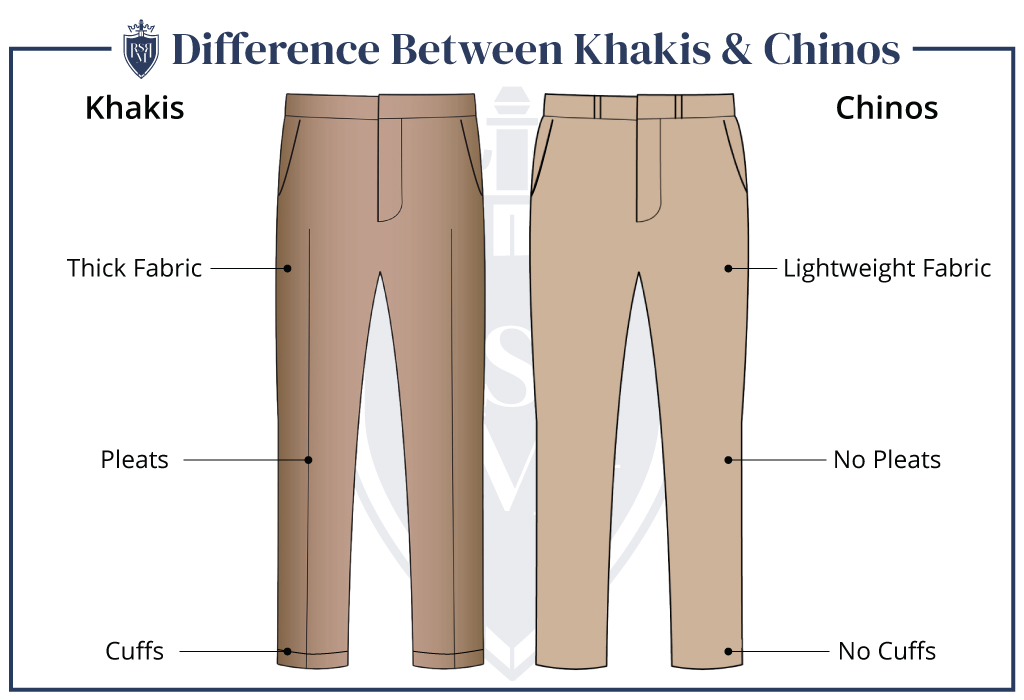
So here's your definitive answer, insofar as there is one. Manufacturers and advertisers have strayed from these boundaries enough that you'll have to take this with a big old grain of salt, but broadly speaking here are the differences:
- Khakis are thick, straight-legged, and typically pleated (although plain fronts are available from most brands these days). They have cuffs at the bottom hems.
- Chinos are lightweight, tapered so that they narrow as they go lower on the leg, and can be either cuffed or uncuffed. They are generally flat-fronted.
- Both styles are made from cotton twill, and are traditionally dyed somewhere in between a very pale cream color and a dark tan.
Of the two, khakis are more toward the sturdy work-wear end of things, while chinos are lighter and a bit dressier.
Now, are you going to find exceptions to these rules? Of course you are.
Manufacturers have been labeling any old cotton dress trousers as either one of these words, or sometimes as both, for years. It's entirely possible to find something being sold as “khaki chinos.”
(Technically, that could even be correct. The original meaning of “khaki” is a specific color, from the Urdu word for “dust,” unrelated to any specific style of trouser.
“Chino,” on the other hand, was a specific weave of lightweight cotton twill. So if you took chino cloth and dyed it khaki, you would in fact have “khaki chinos.” Confusing, no?:)
So don't take any of this as gospel. There's no real guarantee that chinos from Brand A are going to be lighter and dressier than khakis from Brand B. You'll have to look at specific types of pants, see what their materials and details look like for yourself.
But in general – khakis, sturdy and utilitarian.
Chinos, lighter and a bit dressier.
Khakis will look more blocky; chinos more streamlined.
Or at least that's the theory.
| KhakisSturdy & utilitarian | ChinosLighter & dressier | |
|---|---|---|
| Fabric & weight | Thick cotton twill, roughly 9–11 oz. Dry, canvas-like hand that holds its own shape. | Smooth lightweight twill, roughly 6–8 oz. Drapes instead of standing up. |
| Leg line | Straight from knee to hem. Squared off, a little blocky. | Tapered, narrowing on the way down for a cleaner line. |
| Front | Traditionally pleated, though flat fronts are everywhere now. | Almost always flat-fronted. |
| Hem | Usually cuffed. | Cuffed or uncuffed — your call. |
| Seams & details | Visible felled seams, heavier hardware, workwear pockets. | Hidden seams, slash pockets, minimal detailing. |
| Dress code | Casual. Won’t carry a blazer convincingly. Weekend | Business casual and up. Takes a blazer well. Office-ready |
| Shoes that work | Boots, camp mocs, beat-up sneakers, boat shoes. | Loafers, plain-toe derbies, chukkas, clean minimal sneakers. |
| Wear them for | Weekends, travel days, yard work — anything with abuse built into it. | The office, dinner, dates, anywhere there’s a dress code to clear. |
| Bottom line | Built to take a beating and still look intentional. | The most useful non-denim trouser you can own. |
Brands label these two words loosely — always check the cloth and the leg line, not the tag.
How To Tell Them Apart Without Reading The Label

Labels lie. Fabric doesn't. So when you're standing in a store holding two pairs of tan cotton trousers and the tags aren't helping, here's the three-step check I run.
One: grab the cloth. Pinch it between your thumb and forefinger. Khaki twill has weight to it — a dry, thick, almost canvas-like hand, usually somewhere in the 9 to 11 ounce range. Chino cloth is smoother and lighter, closer to 6 or 8 ounces, and it drapes over your hand instead of standing up on its own.
Two: hold them up by the waistband. Look at the outline of the leg. If it stays about the same width from the knee down to the hem, you're holding khakis. If it narrows on the way down, that's a chino.
Three: find the outseam. Khakis often carry a visible felled seam down the outside of the leg, heavier hardware, and deeper pockets — all leftovers from their workwear side of the family. Chinos hide their seams and keep the pockets flat and clean.
Three checks, about ten seconds, and you'll be right far more often than the tag will.
A Quick History of Khakis

Of the two terms, “khakis” is older by the better part of a century.
The first khaki trousers were made in 1846 when a British officer serving in the Punjab region traded his company's hot wool trousers and jackets for lighter cloth and looser cuts made from native cotton. He dyed them with a native plant called mazari, which produced a dusty tan color that the locals called “khaki.”

The colonial military stationed in India adopted khakis as their uniform trouser by 1848, and it spread through the rest of the British Empire until the entire British army formally adopted the style as their uniform in 1884.
A Quick History of Chinos

Much of the confusion between khakis and chinos can be traced to the origin of the latter style: “chinos” were khakis, of a sort.
Chino cloth was a lightweight twill weave from China (hence the name). The British and French military were both using chino to make their khaki uniform trousers by the latter half of the 19th century.
When American soldiers serving in the Philippines during the Spanish-American war needed uniform trousers, they found it cheaper and quicker to import from China rather than the United States. Their trousers were made simple and tapered, without pleated fronts, to save on cloth costs, resulting in a smooth, simple style.
The same basic style was used for uniform trousers during World War One, and returning soldiers from both wars brought them into civilian settings. University students in particular took to chinos after WWI, and they have been part of the fashion landscape ever since.

So why are they called khakis? Here's your basic breakdown: khakis originated as a broad category of military trousers, and one specific subset of them evolved into chinos. Buyers have been confused ever since!
But broadly speaking, if you think of khakis as thicker, more squared-off garments, and of chinos as slimmer, more tapered and dressier pants, you're in the right ballpark. Good luck!
When To Wear Khakis vs. Chinos

Knowing the difference only matters if it changes what you pull out of the closet. So here's the practical version.
Chinos are your business casual workhorse. If your office has a dress code of any kind, chinos in stone, olive, or navy will carry you through most of the week — they line up almost exactly with what men are actually wearing to the office now. Put them with a button-down or a fine-gauge knit, add leather — loafers, a plain-toe derby, a clean chukka — and you'll clear almost any business casual room. Chinos also take a blazer, which khakis mostly don't. That one fact is the whole reason chinos live in the dressier half of your closet.
Khakis are for the weekend and the workshop. The heavier cloth and the straighter leg handle abuse — travel days, yard work, a long Saturday where you're going to end up sitting on the ground at some point. Wear them with boots, camp mocs, or sneakers you don't care about, and let the top half go casual too: an OCBD with the sleeves rolled, a flannel, a chore coat. Try to dress khakis up with a sport coat and you'll usually just look half-dressed.
Two things will sink either pair faster than picking the wrong one. First, color. Anything with a yellow or orange cast fights your shoes and washes out your face — stick to a cool stone, a deep tan, or olive. Second, fit. A $40 pair hemmed by a tailor beats a $180 pair straight off the rack every time. Get the break right — a slight dent on the shoe, nothing more — and nobody's going to ask you which one you're wearing.
Also read: Fuller Chinos vs. Slim Fit: When to Wear What
FAQs: Khakis vs Chinos: What's The Difference?
What is the main difference between khakis and chinos?
The main difference lies in the fabric. Khakis are typically made from a heavier, more rugged fabric, while chinos are made from a lighter, smoother fabric.
Can chinos be khaki-colored?
Yes, chinos can be khaki-colored. The term "chino" refers to the style of the pant, not the color.
What is the difference in fit between khakis and chinos?
Khakis tend to have a more relaxed and straight fit. On the other hand, chinos often have a slimmer, more tapered fit.
Are chinos dressier than khakis?
Chinos are generally considered to be dressier than khakis due to their lighter fabric and slimmer fit, though this can vary depending on the specific style and brand.
Which is more durable, khakis or chinos?
Generally, khakis are more durable due to their heavier fabric, making them suitable for jobs that require a lot of physical activity or outdoor conditions.
Can khakis be worn for business casual attire?
Yes, khakis can be part of a business casual outfit, especially when paired with a dress shirt or polo.
Are chinos suitable for formal occasions?
While not suitable for strictly formal occasions, chinos can be dressed up for semi-formal events or business casual environments.
What are the washing instructions for khakis and chinos?
Always check the garment's care label. Generally, both can be machine washed with similar colors. Hang them to dry to prevent shrinkage and maintain the shape.
Are chinos and khakis the same as dress pants?
No, chinos and khakis are less formal than dress pants, which are usually made of a finer wool or wool blend fabric.
What shoes work best with khakis?
Khakis pair well with casual shoes like loafers, boat shoes, or even clean white sneakers for a more relaxed look.
What shoes should I wear with chinos?
Chinos are versatile and can be paired with a wide range of shoes, from formal oxfords and brogues to casual sneakers.
Can khakis or chinos be worn with a blazer?
Yes, both can be paired with a blazer for a smart casual look. The color and style of the blazer should complement the pants.
What's the price difference between khakis and chinos?
Price varies widely based on the brand, fabric quality, and design. However, due to the heavier fabric and durability, khakis can sometimes be more expensive than chinos.
What's the appropriate occasion for wearing khakis?
Khakis are great for casual events, outdoor activities, or work environments that don't require a formal dress code.
Where can I wear chinos?
Chinos are versatile and can be worn to a variety of events, from casual social gatherings to a business casual office environment.
Can women wear chinos and khakis?
Absolutely. Both chinos and khakis are unisex styles and can be found in cuts and fits designed for both men and women.
Want more?
Discover How The Right Image Helps You Make More Money, Attract Women, & Command Respect with my proven step-by-step mens style master program.