Ever catch a whiff of something — a cologne, a campfire, your grandmother's kitchen — and suddenly you're twelve years old again?
That's your brain doing what it has done your whole life. It pairs a smell with a feeling and files them together. Most men let that happen by accident.
Here's the thing: you can do it on purpose. That's scent anchoring — also called olfactory anchoring, scent conditioning, or olfactory conditioning — and it's one of the simplest ways to put yourself into a focused, confident state on command.
In this article, I'll show you why smell builds the strongest anchor, give you the exact 5-step protocol to build one, and point out the three mistakes that quietly break it. Let's get into it.
#1 What Is Scent Anchoring? (Olfactory Anchoring, Scent Conditioning — Same Idea)

Scent anchoring is the process of linking a specific smell to a specific mental or emotional state, so that smelling it later brings that state back.
You'll see it under four names: scent anchoring, olfactory anchoring, scent conditioning, and olfactory conditioning. “Anchoring” comes from NLP (neuro-linguistic programming), and it's the word Tony Robbins made famous. Watch him on stage and you'll see him pound his chest or throw a fist pump at the exact moment he hits a peak state. That gesture is his anchor.
“Conditioning” comes from psychology and goes back to Pavlov, who paired a bell with food until the bell alone made his dogs salivate.
Different vocabulary, same mechanism. Pair a cue with a state enough times, and the cue starts pulling up the state on its own. Smell just happens to be the strongest cue you've got. (If you want the full research background, read my breakdown of the science of scent conditioning.)
#2 Why Smell Builds The Strongest Anchor

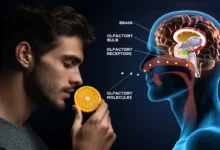
Your other senses check in with a relay station first. Sight, sound and touch all route through the thalamus before they reach the rest of the brain. Smell skips that step. It's the only sense that bypasses the thalamus and connects almost directly to the limbic system — the part of your brain that runs emotion and memory.
That shortcut shows up in the research:
- Smell memories hit harder. In a 2002 study, Brown University psychologist Rachel Herz found that memories triggered by a smell were significantly more emotional than memories triggered by seeing the same object, and they made people feel more “brought back” to the original moment.
- A paired scent can pull a memory back up. In a 2007 study published in Science, German researchers had volunteers learn a memory task while smelling rose scent, then released the same scent while they were in deep sleep. Their recall improved. But when the rose scent hadn't been there during learning, it did nothing.
That second study is the one to remember. The scent had no power on its own. It worked because it had been paired with the task first. That's olfactory conditioning in a nutshell, and it's exactly what you're going to build. (For the bigger picture of how smell shapes emotion, see my guide to the psychology of scent.)
#3 How To Anchor A Scent: The 5-Step Olfactory Conditioning Protocol

Here's the protocol I recommend. It borrows the anchoring steps Robbins teaches and adds what the smell research tells us.
Step 1 — Pick ONE State
Not “better.” One state. Focus for deep work. Confidence before a presentation. Calm before a hard conversation. One scent, one job. A scent asked to do everything ends up doing nothing.
Step 2 — Choose A Distinctive Scent You Don't Already Wear
In a 1997 experiment, Rachel Herz had people learn words with a scent in the room and recall them two days later with the same scent present. An unfamiliar floral scent, osmanthus, improved recall more than any other condition. A familiar pine-cleaner smell didn't help at all. So skip anything that smells like a household product, and skip the cologne you've worn to every wedding since 2015.
There's a second reason to go new. Brain-imaging research suggests the first association your brain makes with a smell gets special priority. A blank-slate scent lets you write that first association yourself instead of fighting ten years of old ones.
Step 3 — Get Into The State For Real
Your anchor is only as strong as the state you attach it to. Sniffing a bottle while you scroll your phone won't anchor focus. Do the work that actually produces the state: a 90-minute deep-work block, a hard workout, rehearsing your pitch until it lands.
Step 4 — Fire The Scent At The Peak
When the state is at its strongest — locked in, sharp, confident — apply or smell the scent and take two or three slow breaths through your nose. Timing matters. Robbins anchors at the peak of the feeling, not at the start or on the way down.
Step 5 — Repeat, Then Test
One pairing won't do it. Run the same pairing several times a week for a few weeks. Then test it: on a flat day, smell the scent cold and notice whether your focus or confidence shifts. If the effect is weak, go back to Step 3 and pair it with a stronger state. Judge it by the test, not the calendar.
| What To DoThe action | Why It WorksThe reason | |
|---|---|---|
| 1. Pick one state | Choose a single target: focus, confidence, or calm. | One scent with one job builds a clean association. |
| 2. Choose a new, distinctive scent | Use a scent you have never worn. Avoid anything that smells like a household product. | Unfamiliar scents make stronger memory cues, and the first association a smell gets carries extra weight. |
| 3. Get into the state for real | Do the work that creates the state: deep work, training, rehearsal. | The anchor is only as strong as the state you attach it to. |
| 4. Fire at the peak | Apply or smell the scent when the feeling is strongest. Two or three slow breaths. | Pairing at the peak links the scent to the full state, not a weak version of it. |
| 5. Repeat, then test | Pair it several times a week for a few weeks, then smell it cold on a flat day. | Conditioning is built by repetition. The test tells you if it took. |
| Bottom line | Keep the scent exclusive, never use it on a bad day, and go light — your nose stops noticing a scent it smells all day. | |
Scent anchoring is also called olfactory anchoring, scent conditioning, and olfactory conditioning.
#4 3 Mistakes That Break A Scent Anchor

Mistake #1 — Using the scent everywhere. If your focus scent is also your gym scent, your date scent and your Saturday-errands scent, it stops meaning anything. Keep it exclusive to the state you're building.
Mistake #2 — Anchoring it to a bad day. Conditioning works in both directions. Wear your confidence scent the day your boss chews you out, and you've just paired it with the wrong feeling. On a rough day, leave the bottle in the drawer. I cover this in more detail in my article on using scent psychology to master productivity.
Mistake #3 — Overdoing it. Your nose adapts fast. Smell the same thing all day and it stops registering — that's olfactory fatigue. Two sprays on skin, or a quick breath from the wrist at the right moment, beats marinating in it.
#5 How We Built Scent Conditioning Into Mission Fragrances

Full disclosure: I care about this enough that I built a company around it.
At Mission Fragrances, we call our colognes Scent Triggers, because that's the job they're built for. There are three, and each one has its own part of the day:
- Honor — morning. Fresh and zesty, for starting the day with discipline.
- Courage — daytime. For the moments where you need to step up and act.
- Commitment — evening. Warm woods and amber, for nights out and the people who matter most.
Because they're new to your nose, they pass the Step 2 test automatically. Because each one has a single job, you're not muddying the anchor. And we built the Mission Fragrances Academy to walk you through the anchoring process step by step, including getting clear on what you want those states to serve in the first place.
If you want to try scent anchoring without guessing at the scents, start with Mission Fragrances. And if you're skeptical (good), read my science-backed review of Mission Fragrances first.
Scent Anchoring FAQ
Is olfactory conditioning the same as scent anchoring?
For practical purposes, yes. Scent anchoring and olfactory anchoring are the NLP terms; scent conditioning and olfactory conditioning are the psychology terms. All four describe the same thing: pairing a smell with a state until the smell triggers the state.
Can I use my current cologne as a scent anchor?
You can, but it's the harder road. Your everyday cologne already carries years of mixed associations — good days, bad days, the commute. A scent you've never worn gives you a clean slate and a stronger first association.
Does scent anchoring actually work?
The mechanism is solid. Smell's link to emotion and memory is one of the best-documented findings in sensory science. The research on using it deliberately for performance is smaller, so treat it as a tool you test on yourself. Build the anchor with the protocol above, run the Step 5 test, and let your own results decide. Some brands take a different route and design scents to act on the brain directly — that's functional fragrance, which I break down separately.
Start this week. Pick one state, choose one new scent, and pair them every time you hit that state. Put in the reps, and in a month you'll have a switch you can flip on command.