What Is Functional Fragrance? Neuroscents Explained For Men
Cologne used to have one job: smell good.
Now there's a whole shelf of bottles promising to calm you down, sharpen your focus or lift your mood. The industry calls it functional fragrance, and in places the marketing has gotten out ahead of the science.
In this article, I'll explain what functional fragrance actually is, decode the buzzwords (neuroscents, medi-scents, aromachology), show you what the research supports and what it doesn't, and give you a simple way to make one work for you. Let's get into it.
#1 What Is Functional Fragrance?
A functional fragrance is a scent designed to change how you feel or perform. Smelling good is part of the deal, but it isn't the whole job. A regular cologne is built for the people around you. A functional fragrance is built for the man wearing it.
Brands go about it two ways:
Ingredient-led. The perfumer builds the scent around notes and molecules that have research linking them to calm, alertness or mood.
Ritual-led. The scent is tied to a specific moment — a morning routine, a desk reset, a wind-down before bed — so the habit does part of the work.
The best products do both. Remember that, because it's the key to everything later in this article.
#2 Neuroscents, Medi-Scents And Aromachology: The Terms Decoded
Functional fragrance comes wrapped in a lot of vocabulary. Here's what each term means in plain English.
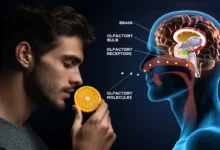
Neuroscents. A brand term for functional fragrances built from ingredients that have been tested for how the brain responds to them. The big fragrance houses have spent years on this. IFF says it has tested thousands of fragrance notes for links to emotional states, and Givaudan built a database called MoodScentz around three of them: invigorated, happy and relaxed. Niche brands like Vyrao have developed their neuroscents with IFF.
Medi-Scent. A trend label the Global Wellness Summit uses for fragrances positioned as wellness tools. The pitch is basically biohacking through your nose: scent used on purpose to help your brain and body perform.
Aromachology. This is the science underneath it all. The term was coined in the 1980s by the Sense of Smell Institute, a division of The Fragrance Foundation, to describe the study of how smells affect mood and behavior. It was deliberately kept separate from aromatherapy, which makes therapeutic claims about essential oils.
Aromatherapy. The older cousin. It starts from essential oils and health claims. Functional fragrance starts from perfumery — it still has to smell good enough that you want to wear it.
Functional Fragrance Terms, Side By Side
What each one is, and what you can realistically expect
What It IsDefinition
What To ExpectRealistic results
Aromatherapy
Essential oils used for therapeutic and health benefits.
Pleasant, often helpful for relaxation. Strong health claims deserve skepticism.
Aromachology
The science of how smells affect mood and behavior, coined in the 1980s by the Sense of Smell Institute.
Not a product. It is the research field the rest of this list draws on.
Functional fragrance
A wearable scent designed to change how you feel or perform, beyond how you smell.
A modest nudge, best supported for alertness. Results vary from man to man.
Neuroscents
Functional fragrances built from ingredients tested for how the brain responds to them.
Backed by fragrance-house research. Treat label claims as a starting point and test them yourself.
Scent anchoring
Pairing a scent with a specific state until the scent triggers that state on its own (also called scent conditioning).
Often the strongest effect, because you build it yourself. It takes a few weeks of consistent pairing.
Bottom line
Buy the chemistry, build the conditioning. A functional fragrance paired with a scent anchor beats either one alone.
Functional fragrances are not medical treatments. Effects vary from person to person.
#3 Does Functional Fragrance Actually Work?
Here's the honest answer: some of it does, and some of it is ahead of the evidence.
What holds up. Smell has a uniquely direct line to the brain's emotion and memory centers — that part is well established. And scents can make you more alert. Even skeptics accept that one. Columbia University neuroscientist Stuart Firestein, who is openly cautious about neuroscent claims, agrees scent can raise alertness.
What's shaky. Many of the studies behind specific products are small and short. Scientists still haven't found a consistent brain-activation pattern for a given scent. And the same smell can land as pleasant for one man and unpleasant for the next.
What surprises people. Expectation plays a big role. Research summarized by the Sense of Smell Institute found that when people were told a scent was relaxing, their heart rate and skin conductance showed relaxation. Told the same scent was stimulating, they showed stimulation.
That last finding isn't a knock on functional fragrance. It's a clue. What you believe about a scent, and what you've paired it with, moves the needle as much as the molecules do.
#4 The Missing Piece: Chemistry Plus Conditioning
This is the part most functional fragrance brands don't tell you.
A well-built functional fragrance gives you a nudge. Conditioning gives you a trained response. Take a calming evening scent. On its own, it might take the edge off. Now pair it with ten minutes of slow breathing every night for three weeks. At that point the scent carries that entire wind-down with it, and one breath of it starts the process.
The brands sell you the chemistry. Most men skip the conditioning, and then decide the product “didn't work.” My rule is simple: buy the chemistry, build the conditioning. I lay out the full method in my guide to scent anchoring, and the research behind it in the science of scent conditioning.
#5 How To Use A Functional Fragrance (A Daily Routine For Men)
Give each scent one job and one time slot. Morning focus, afternoon reset, evening calm. Don't wear your focus scent to bed.
Apply it as a ritual, not on the run. Same moment, same place, every day. Spray, then take two slow breaths before you start the task.
Go light. Two sprays. Your nose tunes out a scent it smells constantly, so more isn't better.
Pick one you actually like. If you don't enjoy wearing it, you'll stop — or worse, you'll link it to irritation instead of focus.
Measure it. For two weeks, rate your focus or calm from 1 to 10 on the days you wear it and the days you don't. Your own numbers beat any label.
#6 Mission Fragrances: Functional Fragrance Built For Men
Most functional fragrances are sold as mists and roll-ons aimed at wellness routines, not at a man getting dressed for work or a date. When I created Mission Fragrances, I wanted the function without giving up a cologne you'd be proud to wear.
So we built it around chemistry plus conditioning from day one. There are three Scent Triggers, each with one job: Honor for the morning, Courage for the day, and Commitment for the evening. And the Mission Fragrances Academy teaches you how to anchor each one to the state you want, so you're not relying on the bottle alone.
No. Aromatherapy starts from essential oils and makes health claims. Functional fragrance starts from perfumery: it targets a feeling or a state, but it's built to smell good enough to wear as your cologne.
Are neuroscents legit?
The research on how smell affects mood is real. The specific claims on a product label are marketing until you test them yourself. Wear it for two weeks, measure how you feel, and decide on your own results.
Can a regular cologne become a functional fragrance?
Yes, through conditioning. Pair a cologne you don't wear yet with one specific state, over and over, and it starts to trigger that state. That's scent anchoring, and it works with any scent you're willing to keep exclusive.
Start with one scent and one job. Wear it with intention, measure what happens, and put in the reps. That's how a bottle of cologne becomes a tool.
I'm Antonio Centeno, the founder of RMRS. I'm a former Marine Corps Officer with a BA in Evolutionary Biology and Philosophy (Cornell College 98') and an MBA from The University Of Texas at Austin (07'). I studied the Science of Style in London, Hong Kong, and Bangkok and have created over 5000 videos/ articles to help men dress better. Click here to discover more about me and our mission here at RMRS.
Ready to earn more money and command respect with the right clothing? Want to start dressing sharp today? Click here to discover The Style System , the BEST Professional Style Course on the planet!