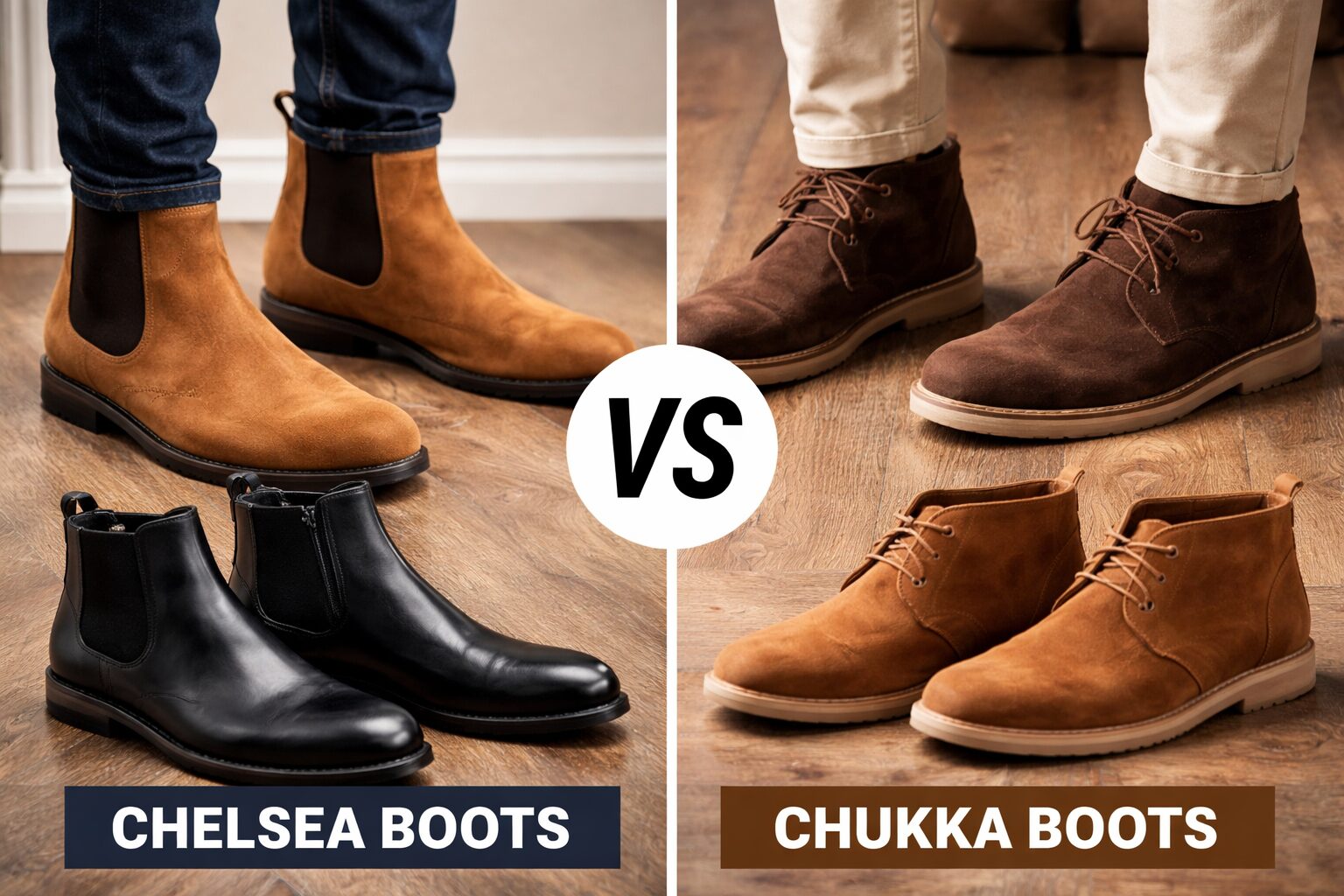
Chelsea Vs Chukka Boots: Which Should You Buy First?
Chelsea or chukka boots for men – which would you choose?
Sure, you can own both. But most guys buy one pair first – and that first pair has to earn its spot. It needs to work at the office, at dinner, and on a Saturday with jeans.
Here's the deal: in the Chelsea vs chukka boots debate, the right answer comes down to two things – how dressy your week is and how your feet are built. Below I'll break down both boots, show you how dressy each one can go, explain how each should fit, and give you a straight answer on which to buy first. Are you a Chelsea man, or a chukka man?
Let's get to it.
Chelsea Vs Chukka Boots At A Glance
Chelsea vs. Chukka Boots
The head-to-head at a glance
Chelsea BootLaceless, elastic sides
Chukka BootOpen-laced, 2–3 eyelets
How it closes
Elastic side panels and a pull tab. Slide in, done.
Short open lacing you can loosen or cinch.
Common materials
Smooth calfskin or suede
Suede or soft calfskin
Common soles
Leather (dressier) or rubber (all-weather)
Leather, rubber, or crepe (desert boot)
Dressiest it goes
A business suit — in sleek black or dark brown leather Higher ceiling
A casual suit in tweed or flannel — leather sole only Lower floor
Fit adjustment
Fixed opening — the boot has to fit out of the box
Laces adjust for a high instep or narrow heel
On and off
Seconds. Great for airport security.
Quick, but you’re tying laces
Best with
Suits, slim trousers, dark denim
Chinos, cords, cuffed jeans, sport coats
Bottom line
Buy first if you wear a suit even a few times a year.
Buy first if your week runs on jeans and chinos.
Chelsea Vs Chukka Boots For Men #1 – The Chelsea Boot
Think about dress boots with no laces. Boots that can be slipped on and off…without tying or untying strings. And instead, there's a loop at the back which you can conveniently tug on to remove the boots each time.
Are boots like those actually stylish? Absolutely – cue in Chelsea boots.
Chelsea boots are unique. They were created without traditional boot laces and instead of becoming a fad…they would become timeless. So what is their appeal?
For starters, they have a lot of flexibility. The fact that they're laceless means you don't have to do anything to tighten the boots manually. Chelsea boots have elasticated side panels which adjust to your feet once you slide them inside. To help with the sliding, simply use the small loop at the back of each boot.
Another factor is their clean silhouette. Chelsea boots don't have the same “mess” as other boots tend to show when the laces are tied. So imagine walking from your home to the subway station, to board the train and then get off…before entering the building for your job interview. No need to look down – your boots are fine and don't require retying. One less issue to worry about. That's the beauty of the Chelsea.
Finally, these boots have been popular throughout history. Queen Victoria's bootmaker, J. Sparkes-Hall, patented the elastic-sided design in 1851 – and the Queen walked in hers daily. A century later they came roaring back in 1960s London. The world got to see bands like the Beatles and Rolling Stones perform in Chelsea boots all the time. These boots had the elegance to balance out their casual “rock star” wardrobe. And this helped prove how versatile Chelsea boots really are.
Chelsea Vs Chukka Boots For Men #2 – The Chukka Boot
Who would've thought that desert boots (which British soldiers had worn during World War II for practical reasons) would lead to the invention of one of today's most fashionable boots?
The name comes from polo, where a chukka is a period of play. But those wartime desert boots – which Clarks launched as its Desert Boot in 1949 – are what put chukka boots on the map. Here's what you should know about them.
Chukkas are low-ankled leather boots which only have a few pairs of eyelets. They tend to resemble dress shoes except for these details:
Chukkas are open-laced rather than closed-laced – the quarters (back part of the upper) are thrown over the vamps instead of beneath them
The flaps are a little more spread apart (due to the open lacing system) which makes the boots more casual than formal
Common materials for the uppers are suede and soft calfskin, while the soles are commonly made of crepe rubber instead of leather
Even though they've got laces and they don't cover up the lower legs…chukkas are still a great way to change up your shoe style. They can still help you stand out in a room filled with other guys in oxfords or loafers. Why? Because of their bulky structure. They add more “weight” to your feet and lower body altogether. That makes you more attractive and masculine.
The open lacing system also gives your feet more breathing room (which is why chukkas feel quite comfortable). But since open-laced is more casual, try not to wear chukkas outside of social events and laid-back environments. These boots wouldn't work with a business suit – but are definitely compatible with a sports jacket plus jeans or odd trousers.
To level-up your chukkas, find a version with just 2 pairs of eyelets on each boot (4+ makes them casual). And check that they're made out of high-end leather that feels very smooth. That's how you'll look as classy as possible in chukkas.
Chukka Vs Desert Boot: What's The Difference?
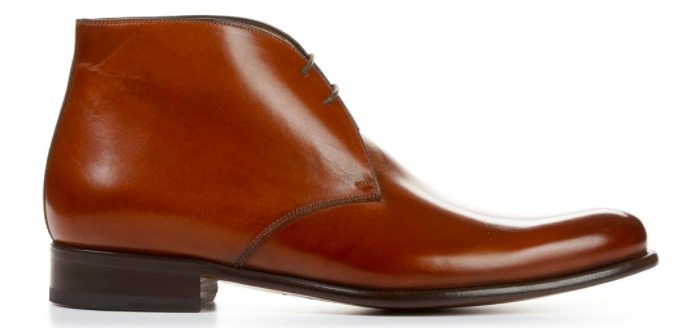
Guys use these two names like they mean the same boot. They don't – quite. A desert boot is one specific kind of chukka: suede upper, crepe rubber sole, usually unlined. So every desert boot is a chukka, but not every chukka is a desert boot.
That matters when you shop. The desert boot is the most casual chukka you can buy – great with jeans, chinos and a sweater, wrong with a suit. A chukka in smooth calfskin on a leather sole is a different animal. It sits comfortably next to a blazer and flannel trousers. For the full story on the original, read my take on Clarks desert boots.
How Dressy Can Each Boot Go?
The simplest way to think about it: the Chelsea has a higher ceiling, the chukka has a lower floor. Both live comfortably in the middle. Here's how that plays out at four levels of dress.
Business suit. A sleek black or dark brown Chelsea in smooth calfskin, on a slim leather sole, works with a business suit. With a little break in your trousers, most people won't even notice you're in boots. Skip the chukka here – open lacing reads casual next to a navy worsted suit.
Casual suit. This is where the chukka gets an invite. A leather-soled chukka in brown calfskin or dark suede pairs well with tweed, flannel, or corduroy suits – the texture in the cloth matches the texture of the boot. Leave the crepe-soled desert boots at home.
Business casual. Both boots win. Odd trousers, an oxford cloth button-down, a sport coat – a brown Chelsea or a leather chukka finishes the outfit.
Weekend. Jeans, chinos, a henley or a crewneck sweater. Suede Chelseas and suede chukkas both shine here, and this is the desert boot's home turf. For more combinations, see how to wear boots with jeans.
One rule holds at every level: suede pulls either boot down a notch, while smooth leather and a thin sole push it up.
Fit Decides It: Which Boot Works For Your Feet?
Most guys pick between these two on looks. I'd let fit break the tie – because a boot that fits wrong looks wrong, no matter how good it looked on the shelf.
High instep or wide feet? Lean chukka. Laces let you open or close the boot to match the top of your foot. A Chelsea doesn't give you that option. The elastic gore stretches a little, but the opening is fixed. If you have to fight to get your foot in, that boot isn't your size.
Narrow heel? Do the heel-slip test. Walk the length of the store in a Chelsea. A little lift at the heel is normal in new leather and settles as the sole breaks in. If your heel pops up with every step, the boot is too big – and wearing it won't fix that. Chukkas hide a narrow heel better because you can cinch the laces.
Watch your trouser break. A Chelsea's clean shaft looks best under slim trousers with a slight break or none at all – one long line from hip to toe. A chukka has more going on at the ankle, so it looks great under cuffed jeans or chinos that stop right at the top of the boot. Fabric piling up on top of either boot kills the look. If your pants pool, that's a job for your tailor, not a new pair of boots.
And one practical note from a guy who lives in airports: I wear Chelsea boots when I fly. Off at security, back on in five seconds, no sitting on the floor tying laces while the line backs up behind me. If you travel a lot, that alone might settle it.
Chelsea Vs Chukka Boots: Which Should You Buy First?
That's the big question.
Personally, I'd recommend buying both types of dress boots if one has the budget for it. But that's not the case for everybody. So I think you ought to go for Chelsea boots.
Both types offer enough protection. Both can enhance your casual outfits for weekends. But the Chelsea is sleeker and more versatile. It can be dressed up or dressed down. That makes it the better investment.
You can pair Chelsea boots with a business or casual suit, with dark slacks or dark denim jeans. You can wear them to meetings (especially black Chelsea boots), networking events, and job interviews – with the advantage of NOT having to fix any laces.
The winner may be Chelsea boots…but chukkas are still valuable in any man's wardrobe.
Here's my quick decision rule. If you wear a suit even a few times a year – weddings, interviews, the big meeting – buy a smooth-leather Chelsea in dark brown or black first. If your week runs on jeans and chinos, or you've got a high instep, start with a brown chukka in suede or calfskin. Then buy the other one.
6 Tips For Buying Chelsea Or Chukka Boots
1. Avoid choosing black for chukkas. Chukkas are rather too casual for black whereas Chelsea boots can look formal and elegant in black.
2. Consider different options for the color: burgundy, oxblood, dark browns, light or dark gray suede, blue suede, etc. Think about possibly matching it with your top clothing like a suit or sports jacket.
3. Be selective with the leather used. The leather should be easy to clean/shine and should age well.
4. The best-quality boots (either type) are Goodyear-welted or Blake-stitched – never just glued. A Goodyear welt is the easiest to resole and keeps water out better. Blake stitching gives you a slimmer, more flexible boot, but it takes a cobbler with a Blake machine to resole it. Check the product page or ask before you buy.
5. Leather soles look better on boots, while rubber soles provide more traction but tend to be clunky/heavy. Understand the pros and cons of each sole type.
6. The higher the heel (such as Chelsea boots with Cuban heels) the more casual the boot becomes.
Chelsea Vs Chukka Boots FAQ
Are chukka boots dressier than Chelsea boots?
No. The Chelsea is the dressier of the two. No laces means a cleaner line, and a slim black Chelsea passes under a suit. The most formal chukka – smooth calfskin, leather sole, two eyelets – still tops out at a casual suit or smart casual.
Can you wear chukka boots with a suit?
With a business suit, I wouldn't. With a casual suit in tweed, flannel, or corduroy, yes – as long as it's a leather-soled chukka in calfskin or fine suede. Crepe-soled desert boots and a suit don't mix.
Is it worth owning both?
If the budget allows, yes. They overlap less than you'd think. The Chelsea covers your dressier days, and the chukka covers the relaxed ones with a bit of texture a sleek Chelsea can't give you. Between the two, you're covered for almost every situation a man wears boots for.
I'm Antonio Centeno, the founder of RMRS. I'm a former Marine Corps Officer with a BA in Evolutionary Biology and Philosophy (Cornell College 98') and an MBA from The University Of Texas at Austin (07'). I studied the Science of Style in London, Hong Kong, and Bangkok and have created over 5000 videos/ articles to help men dress better. Click here to discover more about me and our mission here at RMRS.
Ready to earn more money and command respect with the right clothing? Want to start dressing sharp today? Click here to discover The Style System , the BEST Professional Style Course on the planet!