Men’s Waxed Cotton Jackets | Wax Jacket Styles | How To Re-Wax & Buy
These days, “all weather” jackets all too frequently aren't.
Too stifling in heat,
Too leaky in rain
Not enough insulation when it get's cold.
Too porous in winds.
There's a lot that can go wrong with your outer shell in bad weather.
Modern technology keeps working on new solutions, and there are some good ones out there. Gore-Tex is decent stuff: lightweight, breathable, and fairly water-resistant.
But for an all-in-one jacket that provides warmth, wind protection, and waterproofing, the best solution may the one that's been around for centuries – the waxed cotton jacket.
What Is Waxed Cotton?
Waxed cotton cloth was originally used to make sails for wind-powered ships. It was the last word in technology, at its time.
Oiled sails had been used for years, since the oiled cloth caught the wind better and stayed lighter when it rained, but for many years they were made from flax fibers treated with linseed oil, which got stiff and yellowed with age. In fact coats and capes made from old sails are where we get the association of fisherman's slickers and the color yellow.
Egyptian cotton treated with paraffin wax allowed the creation of the light, waterproof sails that the fastest “tea clippers” used near the end of the Age of Sail. It rapidly caught on as a practical material for outdoor jackets as well, heavily promoted by the British company Barbour and sons (which still exists today), and the style has stayed with us ever since.
Waxed cotton jackets are doubly waterproofed: not only is the outside treated with a waterproof coating, the individual threads of the cloth are impregnated with wax before the bolt is woven.
The result is a waxy protection that goes all the way through the jacket — unlike a sprayed-on shell, the waterproofing can't wear through.
All-Weather Construction
A good “all-weather” jacket needs to be several things: waterproof, obviously, but also lightweight, breathable, and warm.
Traditional waxed cotton jackets solve the warmth problem by quilting.
Quilted “pockets” in the construction can hold either air or extra padding, depending on how warm the jacket is meant to be. The thinnest, lightest versions, most similar to the Gore-Tex and other “shell” styles we see in outdoor and camping stores, forgo the quilting altogether, using a single layer of thick cotton fabric instead.
Breathability is a natural advantage of cotton. The waxing limits it to some extent, but air still flows much more freely than it can in a synthetic jacket. Waxed cotton jackets tend to be much less stifling than those made from nylon, PVC, or other synthetic materials.
Weight is the primary disadvantage of cotton jackets, particularly if they do soak through and become wet.
There's little that can be done to reduce the weight, though the best jackets are made from high-quality Egyptian or other long-staple cotton that provides strong, lightweight cloth (think of a very fine dress shirt — it's the same material, woven thicker).
Styles of Waxed Cotton Jacket
Traditional makers like J. Barbour & Sons offer a wide range of waxed cotton styles. Most have practical, tradesman's roots: the fisherman's slicker, the gamekeeper's hunting jacket, and so forth. Here are a few of the most common:
The Slicker or Oilskin: The traditional fisherman's coat falls to the mid-calves and has a wide, double-breasted front and an attached cape on the back. Most also include a hood that buttons beneath the chin. They are extremely protective, especially when paired with waders, but are heavy and not the most stylish choice.
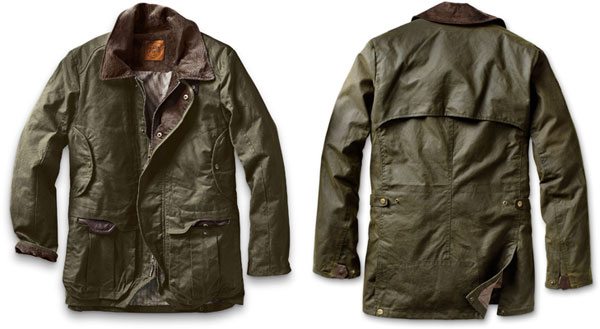
The Hunting or Hacking Jacket: A thigh-length coat with a vent (slit) up the back to allow for riding. Double- or single-breasted models are both common, going up to the neck in either case and meeting a turndown collar. The collar is often done in brown corduroy.
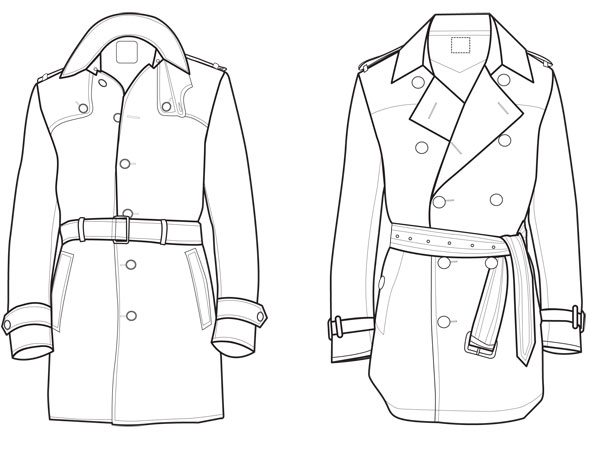
The Field Jacket: A military style falling to just below the waist, with large front pockets and a built-in belt. Epaulets are common but not required.
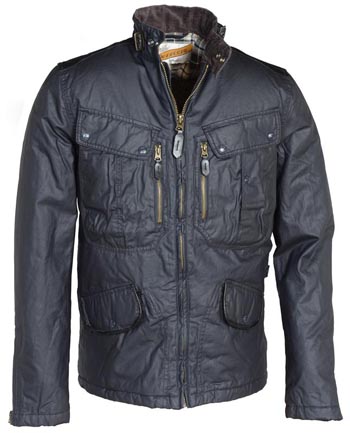
The Moto Jacket: A tight-fitted, waist-length coat with a mandarin (non-turndown) collar and buttoning cuffs. Designed for motorcycle riding — Barbour in particular has a long-running association with cycling, dating back to the early 1930s.
The Trench Coat: The iconic military style: knee-length, built-in belt, epaulets and storm flap. Waterproofed cotton and wool were the original materials for the World War One-era trenchcoats that gave the style its name
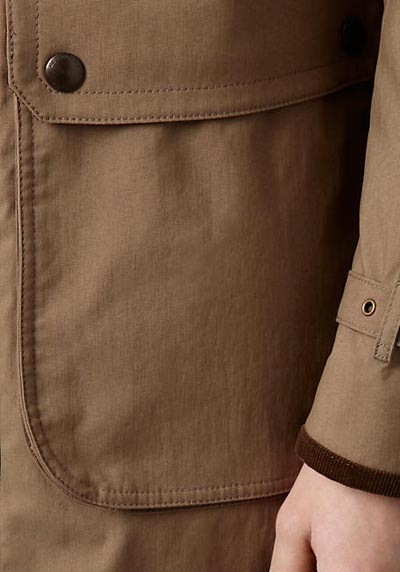
There are many variations on all these basic styles. Hoods are quite common, as are all sorts of extra pockets designed for specific activities and items — shotgun shells, rolls of film, notebooks, and more.
Colors vary depending on brand and marketing, but earth tones are the most traditional. The original chemical process turned the cotton black or dark olive, which early manufacturers balanced with a brown corduroy collar, and all those are still quite common in modern waxed jacket styles.
In any cut or color, the sturdy, finished look of a waxed cotton jacket is a big selling point over more modern outdoors wear — unlike a brightly-colored plastic poncho, it looks like part of an outfit, rather than something draped over it. If you're hiking the Appalachian Trail it probably doesn't matter much; if you're doing business in a big city you'll be grateful for the added class.
Where to Buy A Waxed Cotton Jacket
The Jacket I used in the video – and personally own – is the Eddie Bauer Kettle Mountain Waxed Jacket.
The treatment that gives waxed cotton its breathable waterproofing is a natural one — it will decay over time. Fortunately, it's also one that's easy to restore, unlike a synthetic shell with a chemical treatment.
Re-waxing a cotton jacket can be done at home, or most manufacturers offer a restoring service in-house. The process is fairly simple — softly-heated wax is rubbed into the jacket with a cloth, then allowed to sink in for several hours. The jacket is than gently warmed itself, which lets the wax spread evenly throughout its fibers.
In day-to-day use, the fabric is tough and relatively low-maintenance. If left damp and wadded it can mildew, but hung to dry it largely takes care of itself, apart from the occasional re-waxing.
Important – DO NOT dry clean these jackets. Use cool water and clean with a wet rag. Again – do not use harsh chemical cleaners.
One jacket can last a lifetime or more, properly treated — and, unlike a synthetic shell, a rip can be patched, waxed, and incorporated into the jacket like new.
For A quick summary – please watch my video on the wax cotton jacket:
I'm Antonio Centeno, the founder of RMRS. I'm a former Marine Corps Officer with a BA in Evolutionary Biology and Philosophy (Cornell College 98') and an MBA from The University Of Texas at Austin (07'). I studied the Science of Style in London, Hong Kong, and Bangkok and have created over 5000 videos/ articles to help men dress better. Click here to discover more about me and our mission here at RMRS.
Ready to earn more money and command respect with the right clothing? Want to start dressing sharp today? Click here to discover The Style System , the BEST Professional Style Course on the planet!