Men’s Lapel Flowers & Boutonnieres | How To Wear A Flower In Your Jacket Lapel
Men and flowers?
Flowers are given – not worn.
This is a common notion among men.
The wearing of a flower in one's lapel is the least used gestures of elegance seen in modern times.
Much of this stems from the perception that flowers lie within the domain of the fairer sex.
However this is completely false and a view ignorant of history & biology.
You see men – both kings and soldiers – have worn flowers for hundreds of years.
A freshly picked flower represents fleeting beauty and life, and remind us to live this moment before it's gone.
In nature, and in humans until recently, it's the male of the species who must draw attention to himself with color and adornment to prove himself to society, his peers and mate.
Just look around – outside my window I see the Red Winged Blackbird wearing a boutonniere of sorts.
From a lion's mange to a peacocks feathers – males across the globe know it better to be looked over than overlooked.
A Flower is Manly
Few elements of men's fashion are well understood by the general population.
Fewer still are those particular touches to a gentleman's look, such as the pocket square in a jacket, cufflinks on a shirt, or pleats on trousers which add real character.
Men tend to have an idea of what they like and deviate little from that idea.
Choosing to remain ignorant of such little pops of flair that can turn a decent outfit into an elegant and memorable one.
Perhaps the least understood is the boutonniere, or buttonhole.
This ever-present little line of stitches on the left jacket lapel is seldom utilized and almost never correctly exploited.
This is the gentleman's guide to what this little hole does, what to put in it, and then some final points to remember.
A Buttonhole Without A Button?
The left jacket lapel of a custom suit jacket or sport coat today, more often than not, has what looks like a large buttonhole near the top of the lapel, below the collar.
What confuses fashion neophytes is the lack of a button on the opposing lapel even on the rear side.
Didn't we need to button up our lapels back in the days before overcoats?
Yes, we did but the reason for the hole in the jacket lapel as we know it today isn't because of this old function.
The most popular story is of Prince Albert being presented with a small bouquet from Queen Victoria on their wedding day.
He made the splendid gentlemanly gesture of cutting a hole in his lapel right there, and put the flowers in the lapel.
Thence he had his tailor put the hole is all of his jacket lapels and society followed.
In the U.S., we call it the lapel buttonhole; in the U.K. it is called the boutonniere. “Boutonniere” is French for buttonhole, so this latter is easy to comprehend.
In the U.S., the word “boutonniere” is associated with proms or weddings, as in the flower itself that adorns the lapel. In men's fashion the word “boutonniere” can mean the hole in the lapel or the flower which decorates it.
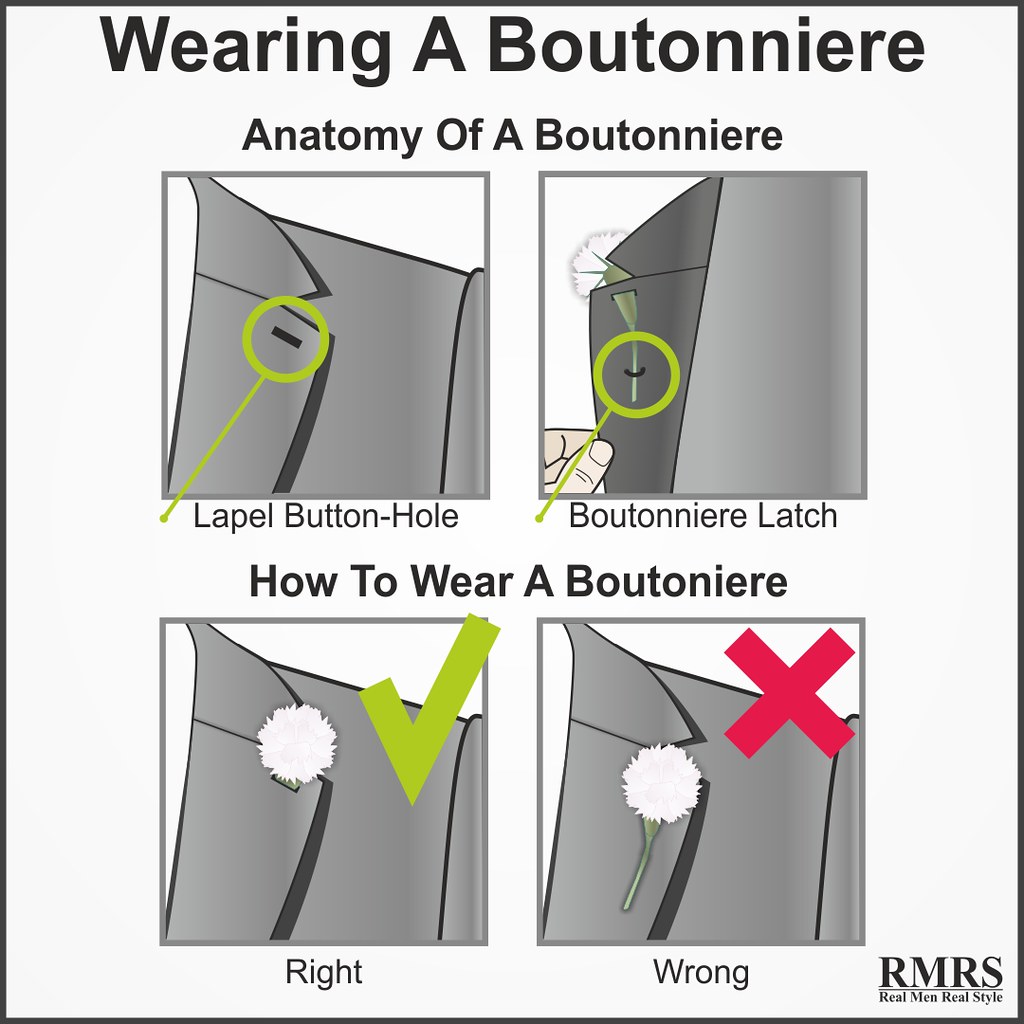
If the buttonhole is present and functioning, be sure before wearing a boutonniere that there is a thread on the rear of the lapel and slightly below the buttonhole.
This thread holds the flower stem against the lapel, thereby holding the flower upright.
Visit your tailor if the thread isn't there, he can add it easily. If the buttonhole is present but not functional, that is, the hole is closed, then you can have the tailor open it, finish it (to prevent fraying), and add the thread behind the lapel.
If you have a jacket lapel that is devoid of the buttonhole, your tailor can sew one into the lapel.
The One Boutonniere Rule
Do not pin the flower to the lapel.
A pinned flower is on par with clip-on neckties and cardboard pocket squares.
They are out there but no gentleman with decent fashion sense wears them. The buttonhole is there for this purpose, so use it.
If the hole is closed, refrain from wearing a boutonniere or simply have the hole cut open.
Approximately one inch below the backside of the button hole should be a latch – this is for holding a water vase and holding the flower in place throughout the day.
Pinning not only ignores the function of the lapel buttonhole, it is bad for garments. The pin can break threads and permanently damage a suit or sport jacket's lapel, just like wearing a tie tack will damage a necktie.
If there is no buttonhole, again, do not pin a flower on.
However: we often wear flowers at weddings and other special occasions – don't offend your family and friends by refusing to pin on a flower when that's what everyone is doing.
Going against the grain in this way is not gentlemanly. Swallow your pride and break the rule in this case.
The Three Boutonniere Guidelines
Wear the boutonniere when you feel it is appropriate. Some men would be very uncomfortable wearing a boutonniere anywhere, some only at the office, and some can wear them all the time.
At a black tie event, a flower will not be frowned upon. Likewise at a professional business meeting; a man with a flower in his lapel stands out and shows real flair for appearances.
Think also on your work environment. If you wear a suit everyday, a flower in the lapel will show some real verve; if it's a jeans workplace, showing up in a suit with a boutonniere would be awkward.
Wear the boutonniere with a pocket square. Well-dressed gentlemen agree that a suit jacket without a pocket square is naked.
If you're not totally comfortable with a pocket square either, try a white pocket square with a white carnation – these will go with nearly any suit/shirt/necktie combination.
Wear the boutonniere with confidence. Once you have decided to wear a boutonniere, let it be as the jacket to you. It's another item on your body, it's neither weird nor hammy.
Install the flower into the jacket lapel and leave it alone unless it requires adjustment.
Heads will turn to the man wearing a boutonniere, so don't feel self-conscious, rather, let the attention bolster your self-confidence.
Don't fidget with the flower or remove it in the middle of the day, unless its appearance is significantly diminished or the flower is damaged.
Traditional social etiquette limits which flowers are worn in the buttonhole for formal occasions, however, I feel a man can wear any flower he so chooses as long as it doesn't clash with the colors in his clothing.
Four of the most common formally worn flowers are the red carnation, the white carnation, the blue cornflower, and the gardenia. Other flowers that can be worn are the white azalea, miniature roses, delphinium, daises, lily of the valley, and even statice.
Any one of these should express a man quite well. If not, many flowers will do, so ask a florist what would look good on you. The flower shouldn't be too big, nor so small that it is not noticeable.
Important Boutonniere Points
We discussed not pinning a flower to the lapel, and here are some more important points to remember when sporting a flower.
Use only fresh, real flowers – no fake ones. Gentlemen do not wear cardboard pocket squares, clip-on neckties/bowties, nor do they don artificial flowers.
If you wear a flower with a pocket square, make there isn't too much going on with your look. If there is, remove the pocket square (fresh flowers won't last long so wear the flower while it still looks its best).
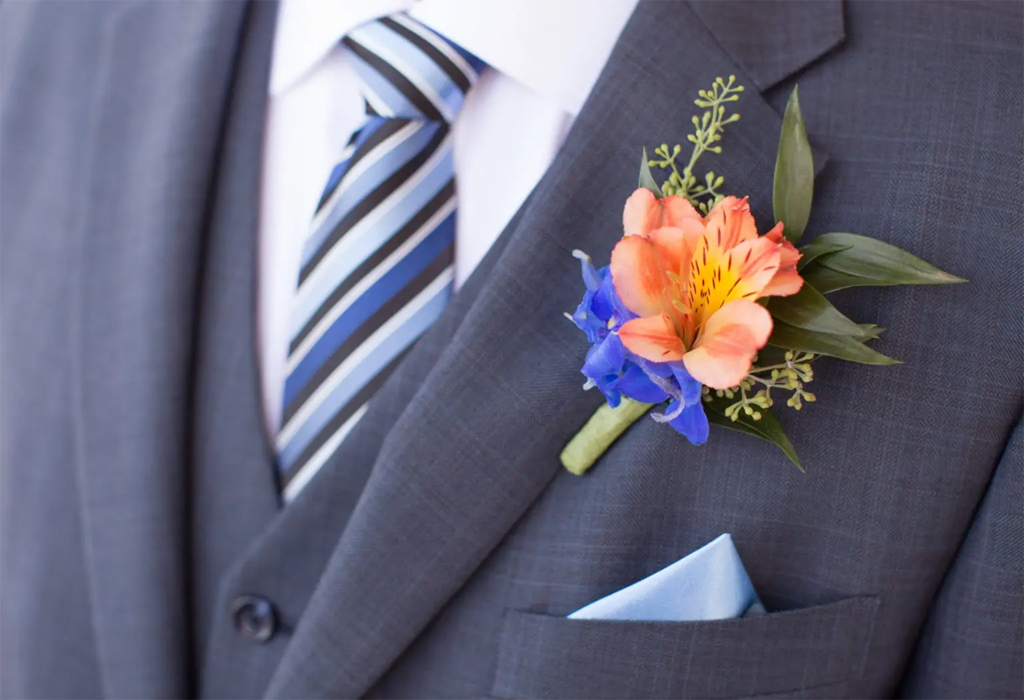
Ensure color harmony with your boutonniere and the rest of your outfit (suit, shirt, necktie, and pocket square).
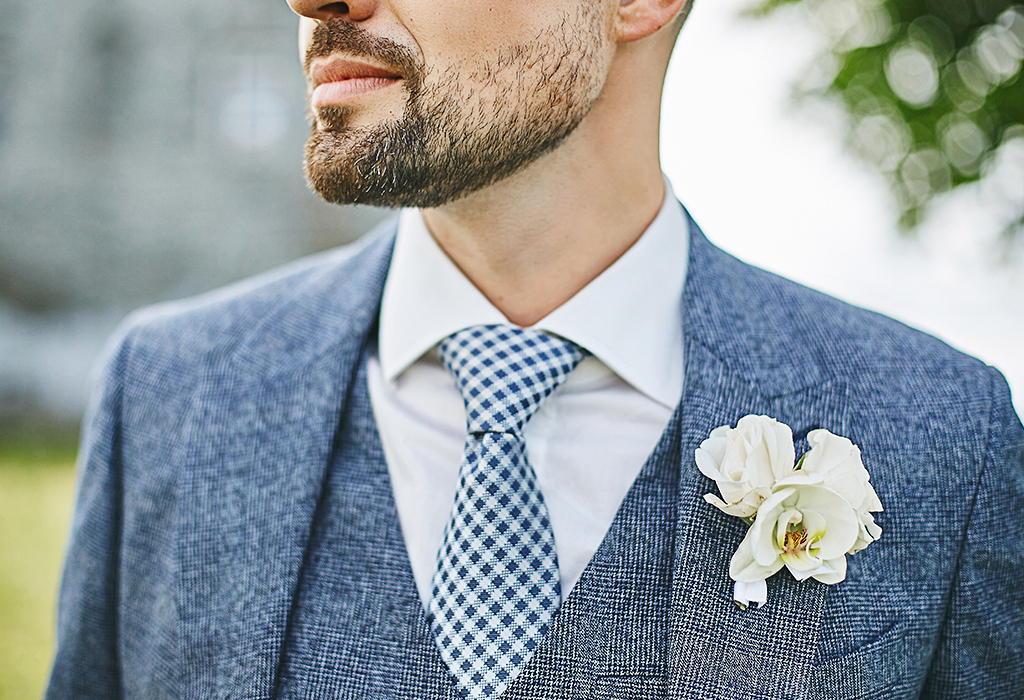
A boutonniere is a single flower, not a small bouquet. No baby's breath or leaves should show.
You may find small vases that either hang from the lapel buttonhole or hold onto the lapel by a magnet. Wear them on the back of the lapel. Your flower is the point of interest, not what's holding it, and the vase should not be seen. If the vase makes the lapel bulge, do not wear it.
Poppy flowers are worn in some countries at a certain time of year in remembrance of fallen heroes. In the U.S., they are worn for Veterans Day or Memorial Day; in other countries, they are specifically for November 11th (Armistice Day).
I'm Antonio Centeno, the founder of RMRS. I'm a former Marine Corps Officer with a BA in Evolutionary Biology and Philosophy (Cornell College 98') and an MBA from The University Of Texas at Austin (07'). I studied the Science of Style in London, Hong Kong, and Bangkok and have created over 5000 videos/ articles to help men dress better. Click here to discover more about me and our mission here at RMRS.
Ready to earn more money and command respect with the right clothing? Want to start dressing sharp today? Click here to discover The Style System , the BEST Professional Style Course on the planet!