Horizontal vs. Vertical Stripes | Fact and Fiction About Striped Clothing
Q: I’ve heard in the past that horizontal stripes make someone look wider and vertical stripes make them look taller and thinner. But I keep seeing studies going back and forth whether this is true. Who do I believe?
A: Three decades or so of research on this question have yielded inconsistent results. A more recent study seems to show that this is because the answer is actually more complicated than we all would like.
BACKGROUND:
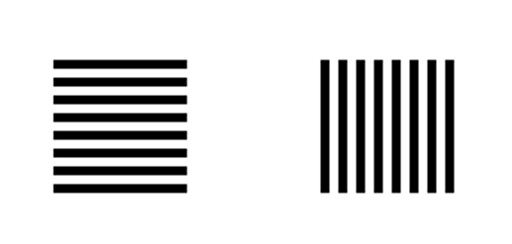
There’s a famous optical illusion called the Helmholtz Illusion, discovered by a man named Helmholtz in 1867.
Which of these squares looks thinner and taller than the other? Most people would say the left square looks thinner and taller.
A number of studies have tested this effect and have found conflicting results. Why would fashion work differently than this famous optical illusion?
Three Japanese researchers noticed some interesting patterns in the previous research. They all presented pictures of models wearing either horizontal or vertical stripes. However, they weren’t using the same models: some were fat and some were thin. Additionally, they were all shaded differently. And finally, they were presented in various orders.
These researchers decided there were multiple factors at play here and published a study testing their hypotheses in the journal i-Perception in 2013.
The researchers did a number of studies testing the possibility that three factors were influencing all the previous research on this subject that has been conducted:
Whether the model is slim or fat.
Whether previous judgments of other people influence later judgments of different people.
Whether judgments are so varied between people that the whole thing isn’t very useful.
The students were placed in a chair and put their chin in a chin rest that ensured that their eyes were a certain distance from a computer screen.
A number of computer images were flashed in the screens depicting people wearing clothing with either horizontal or vertical lines.
The size of the images was digitally altered to be either slim or wide.
Two figures were shown side-by-side for 1.8 seconds. One had horizontal stripes and the other had vertical stripes. Then, participants were to judge which of the images were fatter and press a key indicating their response.
This method was done 20 times with slim figures and 20 times with fat figures, or with the fat figures first and then the slim figures.
RESULTS:
So what do you think – is conventional wisdom true for fashion, or is the Helmholtz Illusion the main driving factor?
The conventional wisdom was not found to be true. Horizontal stripes don’t make people look fatter and vertical stripes don’t make people look slimmer and taller.
BUT sometimes the stripes didn’t really make a difference at all.
Which factors influenced whether the Helmholtz Illusion held true for the figures?
Size of the Model:
YES. Slender models look even thinner with horizontal stripes (supporting the Helmholtz Illusion and going against conventional wisdom).
But this effect was not as strong for the wide models – for wide models, the type of stripe BY ITSELF actually didn’t have as much of an influence at all.
Order of Presentation:
YES. Here’s an interesting result. When SLENDER models were shown first to people, and then wide models, the Helmholtz Illusion was strongest of all (Horizontal stripes make people seem taller and slenderer) for both groups. This applied to both fat and slender images. Again, conventional wisdom does not seem to hold.
When the wide models were shown first, the type of stripe did NOT seem to matter for anyone.
Variance Between Observers:
YES. Significantly, the researchers found that, even though there were noticeable results when they compared averages, there was a wide variety of results across all participants.
DISCUSSION:
So how do we interpret the results of this experiment? Here are some important conclusions that can be inferred from the results:
In no case was the conventional wisdom found to be true. Horizontal stripes did not, on the whole, make someone look wider. Vertical stripes, on the whole, did not make a person look taller and slimmer.
In fact, where there was an effect, it supported the opposite conclusion.
On the fatter models, the kinds of stripes made much less difference.
People’s judgments seemed to be more influenced by what models they had previously judged.
For some reason (that the authors did not fully understand) when participants judged a large group of slender people first, the Helmholtz Illusion got very strong.
What does this mean for laypeople?
It means that when we view a person, we are mentally comparing them to people we have already seen.
Here’s the (very strange but scientifically supported) bottom line:
If a fat person is going to an event full of thin people, horizontal stripes may actually make them look slimmer and taller.
Why? The researchers weren’t sure.
Finally, there was another big take-away:
There was so much variation between participants in the study that the researchers concluded that stripes may not really, on the whole, make that huge of a difference.
This would explain why all the previous studies since the ‘80s were inconsistent.
This makes it seem like, unless you want to make a calculated, complex decision based on the results in this study, you might make your fashion selections based on other factors instead of whether the stripes are horizontal or vertical.
Whenever science doesn’t seem to go one way or the other, I say trust your own personal judgment.
REFERENCE
Ashida, H., Kuraguchi, K., & Miyoshi, K. (2013). Helmholtz illusion makes you look fit only when you are already fit, but not for everyone. I-Perception, 4, 347-351. Link: https://ipe.sagepub.com/content/4/5/347.short
I'm Antonio Centeno, the founder of RMRS. I'm a former Marine Corps Officer with a BA in Evolutionary Biology and Philosophy (Cornell College 98') and an MBA from The University Of Texas at Austin (07'). I studied the Science of Style in London, Hong Kong, and Bangkok and have created over 5000 videos/ articles to help men dress better. Click here to discover more about me and our mission here at RMRS.
Ready to earn more money and command respect with the right clothing? Want to start dressing sharp today? Click here to discover The Style System , the BEST Professional Style Course on the planet!