The Quick Answer (For Men in a Hurry)

After 5,000+ articles and a couple decades fitting men, here's what I tell guys who don't have time for the full guide:
- Match your socks to your trousers, not your shoes. Black socks with charcoal pants makes your feet look big and your legs short.
- Go over-the-calf for business. Mid-calf is the floor. Anything shorter shows skin when you cross your legs.
- Skip 100% cotton and 100% polyester. Cotton soaks but doesn't wick. Polyester runs hot and stinks. Look for merino wool, bamboo viscose, or a wool/cotton blend with a touch of nylon and elastane.
- Pay $15–$30 a pair. A good pair lasts 2–3 years. A $3 pair lasts 6 months. The math is not close.
- Own 7–10 pairs minimum if you wear dress shoes regularly. More if you suit up daily.
The rest of this guide explains the why — and shows you exactly how to spot a quality sock at a glance.
RMRS
How To Buy Dress Socks For Men
Find your perfect sock style
Why Socks Matter More Than You Think
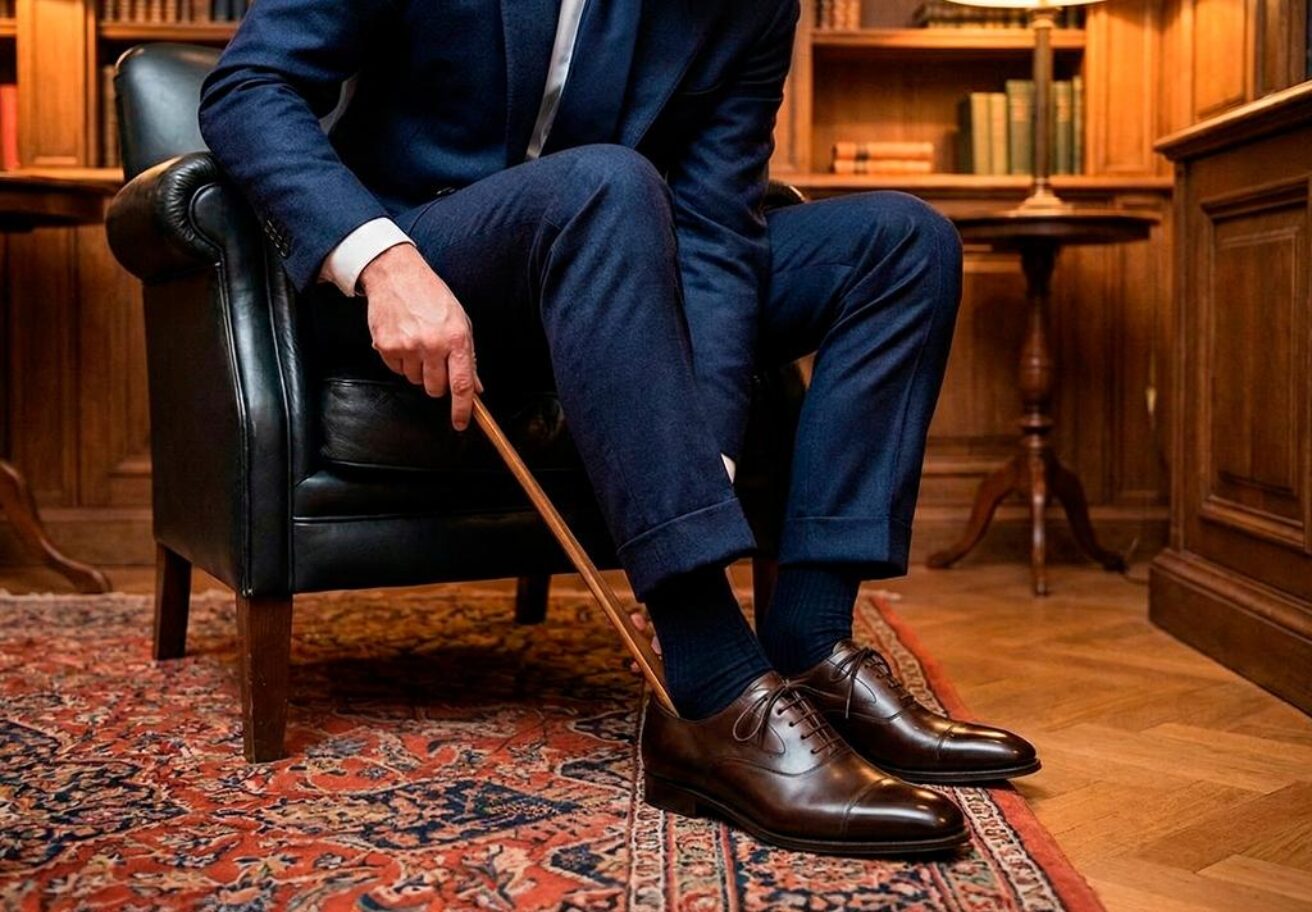
Socks (or, as some of the fancier brands still call them, hose) evolved from a practical need. Human feet sweat heavily, and a covering of cloth, hair, or hide helps absorb that sweat and draw it out toward the air, where it can evaporate.
This sweating can also damage the more expensive outer footwear, so socks serve the purpose of extending the life of your shoes. That was the goal back when humans first started tying animal skins around their feet, and it's still a practical consideration today.
A good sock should not just absorb sweat but also wick it through the material toward the outer surface. That's important so the foot stays dry and sweat evaporates before smell-producing bacteria have a chance to start feeding on it.
To fit in with a contemporary, well-dressed look — especially at business-appropriate levels of formality — a good sock needs a little more than that.
The 5 Things Every Quality Dress Sock Does

These aren't desirable sock qualities. They're essential ones.
Wicking. Socks should pull moisture away from your foot, toward the exterior surface of the sock, so it can evaporate.
Padding. The sock should cushion your foot from impact and stop the skin from rubbing against the inside of your shoes.
A snug fit. A loose sock bunches, which is unsightly, and rubs, which causes blisters. A good sock pulls snug from top to toe.
A slim profile. Dress shoes are fitted snugly, so you can't cram a thick sock in. Dress socks should be as thin as comfort permits — both to fit your shoes and to avoid distorting your trouser cuff.
The right color. Black isn't the automatic answer. A good sock either fits neatly into the outfit or stands out boldly and on purpose — never by accident.
That's a long list. Very few socks hit every note. If you find a brand that fills all five for you, treasure it and buy a lot of back stock — companies discontinue good products all the time.
How to Spot a Quality Dress Sock at a Glance
Most men shop for socks the same way they shop for batteries — grab whatever's cheap, don't think about it again. That's why most men are wearing bad socks.
Once you know what to look for, you can tell a $4 sock from a $24 sock in about ten seconds. Here's the checklist:
1. Check the toe seam
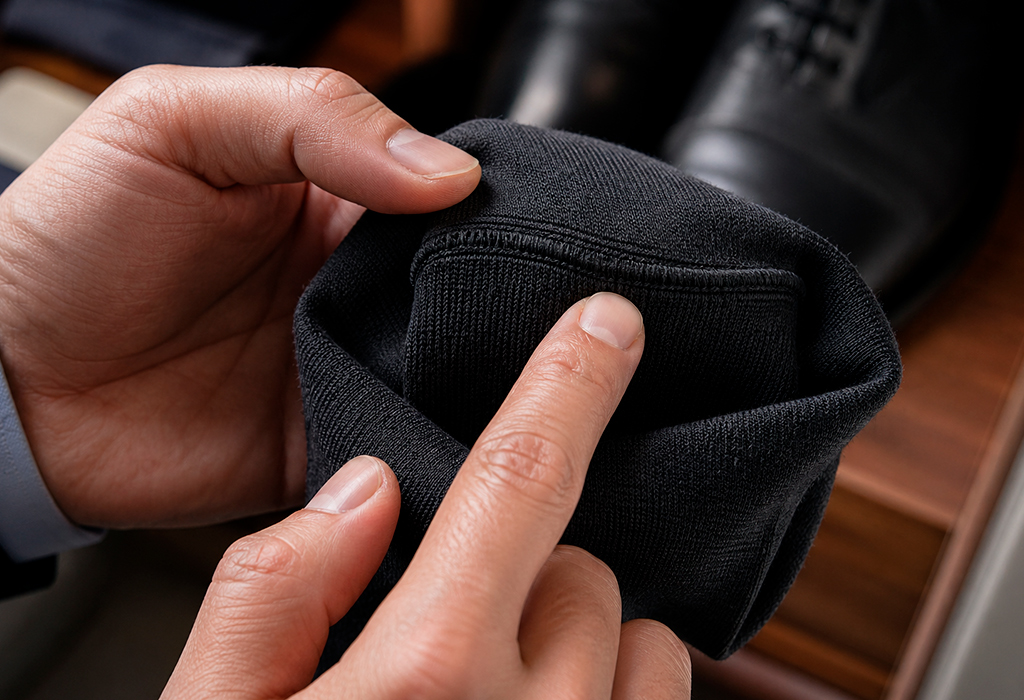
Turn the sock inside out and run your finger across the toe. If you can feel a thick, raised ridge, that's a machine-looped seam — and it will create a pressure point inside your dress shoe within an hour. Quality dress socks use a flat-linked or hand-linked toe closure that lies almost invisible against the skin. Brands like Pantherella and Fort Belvedere hand-link every pair.
2. Look at the needle count
This one's not always on the label, but premium dress socks are knit on machines with 200 needles or more. The higher the needle count, the finer and tighter the knit. The result is a smoother surface, a slimmer profile inside the shoe, and a sock that holds its shape after dozens of washes.
3. Read the fiber percentages, not just the fiber list

“75% merino wool, 23% nylon, 2% elastane” tells you something. “Wool blend” tells you almost nothing. The primary fiber should be at least 70%. Anything less and you're paying for marketing.
4. Stretch the cuff
Pull the cuff outward and let it snap back. A quality dress sock has a tight, springy ribbed welt with elastane (Lycra/Spandex) woven in — not a weak band that drapes loose. That elastic is the whole reason quality socks stay up without garters.
5. Feel the heel and toe

Premium dress socks have reinforced heel and toe zones — areas knit with extra yarn or a denser stitch where the sock takes the most wear. Run your fingers around those points. If they feel the same as the rest of the sock, you'll be looking at thin spots in six months.
Dress Sock Materials: What to Look For
Last but by no means least, the stuff the sock is actually made of has a huge impact on how it performs. Common base materials include cotton, wool, nylon, polyester, and a range of synthetics — some trademarked, others known by their chemical names.
Cotton

On its own, cotton is absorbent, which is good for soaking sweat off the skin. But it doesn't wick moisture toward the surface and it doesn't let wetness evaporate quickly. That makes it good for short bursts of high sweat — a quick cardio workout — but problematic for a full day's wear.
One exception: long-staple cotton. Pima, Egyptian, or Sea Island cotton (often labeled ELS or Fil d'Écosse) has longer fibers that produce a smoother, more durable sock with much better moisture management than standard cotton. If you live somewhere hot and want cotton, this is the cotton to buy.
Wool — Especially Merino
Wool, unlike cotton, breathes easily and lets wetness evaporate. It's also naturally antimicrobial, meaning it resists odor better than any plant fiber. The traditional knock on wool was bulk and itch — true of old-school worsted wool socks, untrue of modern merino.
Merino wool has fibers fine enough to wear next to your skin without itch. It regulates temperature in both directions — warm in winter, cool in summer — which is why it's become the gold standard for premium dress socks. Brands like Darn Tough, Smartwool, and Pantherella's merino lines run $20–$30 a pair and last for years.
Bamboo Viscose

Bamboo viscose is the newcomer in dress socks and worth knowing about. The fiber is softer than cotton, more breathable than synthetics, and naturally resists odor. It also wicks moisture better than cotton — bamboo absorbs moisture faster than cotton does and dries faster too.
The trade-off is durability. Bamboo socks tend to wear out faster than merino wool. If you have sensitive skin or sweaty feet and your office is climate-controlled, bamboo is excellent. For heavy daily rotation, merino is the better long-term investment.
Synthetics
Acrylic, polyester, olefin, and polyethylene can all be shaped into fibers that encourage wicking. On their own, these materials are thin and provide little cushioning, but blended with thicker, stretchier materials they make an excellent sock.
Always avoid 100% polyester dress socks. They run hot, hold smell, and pill quickly. The right place for synthetics is in the blend — about 15–25% nylon for durability and 1–3% elastane for stretch. Those are the percentages that make a quality wool or cotton sock actually fit and last.
So what's the ideal blend?
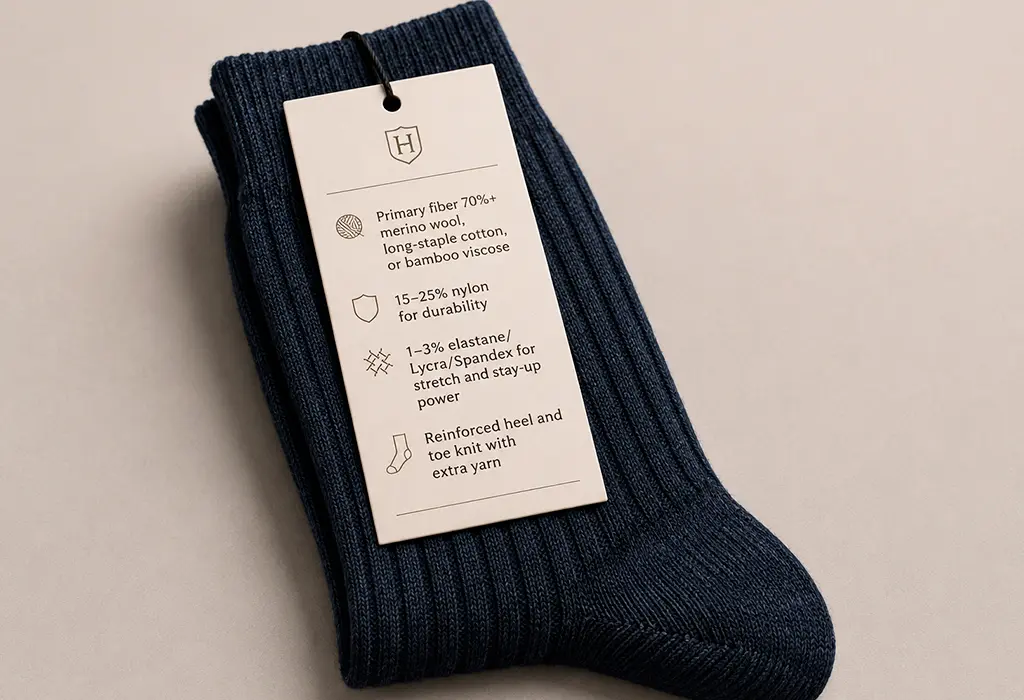
There's no single best blend. Companies use proprietary mixes and many keep them secret. But a great dress sock generally looks something like this:
- Primary fiber 70%+ merino wool, long-staple cotton, or bamboo viscose
- 15–25% nylon for durability
- 1–3% elastane/Lycra/Spandex for stretch and stay-up power
- Reinforced heel and toe knit with extra yarn
If those considerations remind you of outdoor sportswear more than business dress — that's because they're the same engineering principles. The difference is the dress sock packages all of it into something thin enough to fit a sleek oxford.
Sock Length: Where Most Men Get It Wrong

Socks, as you may recall, sometimes go by their more archaic name — hose or hosiery. That comes from the days when exposed skin was considered not just unsightly but downright scandalous.
Tastes have relaxed quite a bit. But not so far that anyone wants to see a scraggly bit of hair-covered ankle sticking out between the top of the sock and the cuff of your trousers.
A good sock for business dress and other high-formality purposes should come at least midway up the calf. All the way to the lower edge of the knee is great if you find that comfortable, but halfway up the calf should be your minimum.
Lower than that and certain positions — one foot flat while seated with the other slung up across the knee, for example — risk exposing a flash of skin that clashes with your sock and your trousers. It looks unsightly. It also shows you don't know better.
Since the cost of manufacturing socks comes mostly from material, length is where a lot of brands look to save. You'll end up with a lot of “calf” socks that really only come up to the top of the ankle. Save those for casual trousers in summer, and hunt for proper over-the-calf socks for dress occasions. Specialized menswear stores and upscale department store sections will serve you better than Target or Walmart for that.
Sock Length by Occasion: Quick Reference
| Occasion | Right Length | Why |
|---|---|---|
| Black tie / formal events | Over-the-calf, silk or fine wool | Skin must never show. Period. |
| Suit / business meetings | Over-the-calf | Stays up all day. Looks sharp when you cross your legs. |
| Smart casual / blazer + chinos | Mid-calf to over-the-calf | Mid-calf is the floor. Match to trouser color. |
| Loafers (no socks shown) | No-show socks | Going sockless ruins the leather. Wear no-shows. |
| Boots with jeans | Crew or mid-calf wool | Warmth and cushion matter more than slim fit here. |
| Athletic / weekend | Crew or ankle, performance fiber | Different beast entirely. Don't mix dress and athletic. |
Want the full breakdown? See: The Right Sock Length for Every Type of Shoe
Sock Color: The One Rule That Changes Everything
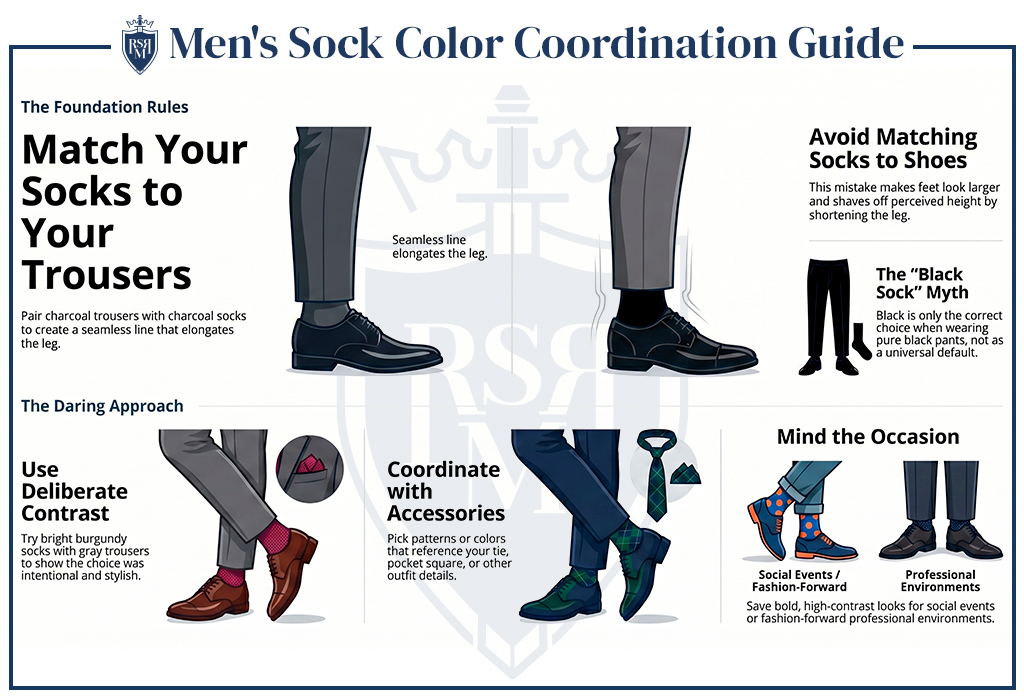
Forget the conventional wisdom of suburban dads. Black isn't the automatic go-to dress sock color, although it's usually an acceptable one.
Savvy dressers have a whole range of options, depending on how much contrast they want in their outfit.
The most basic, play-it-safe rule: when in doubt, match your sock to your trouser leg. Charcoal trousers, charcoal sock. Light gray trousers, light gray sock. Khakis? Light tan. You get the idea.
You may have noticed that black socks don't actually meet that standard very often, except for men who wear a lot of pure black pants.
The idea of black dress socks evolved from an easier but less-attractive rule: matching the sock to the shoe, which for most men in business dress is black. That works in a pinch. It's not awful. But it's not great either. It makes your feet look big and draws attention to your ankles every time the trouser cuff rides up. It also shaves perceived height off your body by making your legs look shorter — which might be acceptable for very tall men but isn't desirable for anyone else.
So what are the alternatives? The most common we already covered — match the sock to the trouser leg. But daring dressers can take it a notch further with a contrasting sock, so long as the contrast looks deliberate. That's a very important caveat.
White gym socks and gray sharkskin trousers isn't going to look deliberate. It's going to look like you got dressed in the dark.
But those same gray trousers with a pair of bright burgundy socks that have a matching gray diamond pattern (argyle or a close cousin) running through them? Now we're talking.
If you go for bright socks, pick ones in a comfortably contrasting color, or ones with a pattern that references colors elsewhere in your outfit — your pocket square, your tie. Or both. Even then, save it for social rather than business occasions, unless you're in a relaxed or fashion-forward industry like tech.
Size and Fit
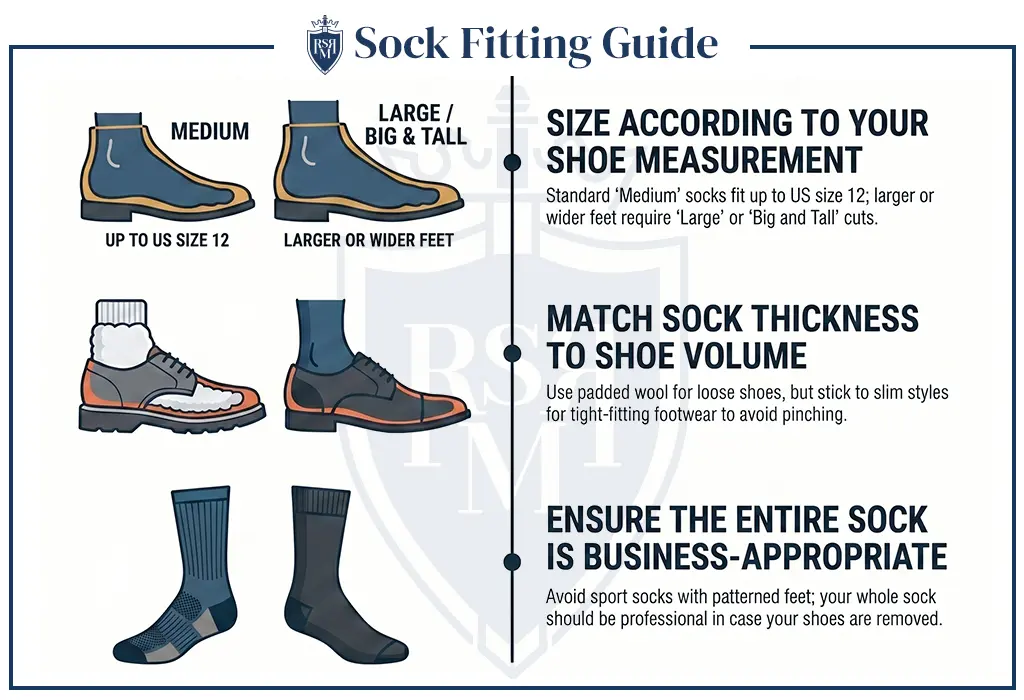
A final consideration is the fit of the sock on the foot itself, not just its height on the leg.
Most socks aren't sized like shoes — although at the very upper end of the market you'll find individually sized socks, and even custom-made options. Brands vary, but generally an off-the-rack “Medium” sock fits up to about a US size 12 shoe. Men at or above that should look for a “Large,” or for long or wide feet, a “Big and Tall” cut.
Keep both the thickness of the sock and the shoe you're going to wear it with in mind. A wool sock with a little extra padding is perfect for shoes that are a touch too big — but murder in shoes that already pinched. Those fractions of an inch start to add up quickly when it's your feet in question.
Tradition holds that the more formal a sock, the slimmer it needs to be — going back to the days when they were fine silk or wool garments woven thin, like the ladies' hose we're familiar with today. These days, a padded wool sock is acceptable in business situations, so long as the bulk doesn't distort the shoe or trousers, and there are no obvious padded sections outlined with stitching or color.
Always remember the possibility of a Japanese-tea-ceremony moment — that moment when you sit cross-legged on a mat and your full sock is on display. Your whole sock should be business-appropriate, not just the upper part visible above the shoe. Beware of sport socks with plain black tops and colorful, patterned padding on the foot itself.
How Many Pairs of Dress Socks Should a Man Own?

Short answer: 7 pairs minimum, 10–12 ideal. If you wear a suit every day, lean toward 10–12. If you only need dress socks for occasional meetings or events, 5–7 is plenty.
The math is simple. A pair of dress socks gets one wear, then washed. A normal man does laundry once a week. So a week's rotation plus 2–3 spares for laundry-day overlap is the floor.
If you want my honest take: most men under-buy on socks and over-buy on shoes. Quality socks rotated through a 10-pair drawer last twice as long as the same socks worn into the ground in a 5-pair drawer, because the elastic gets to recover between wears. Buy more, wear them less often each, and they last for years.
My breakdown for a working professional:
- 4–5 pairs solid charcoal or navy (your daily drivers — match to most suits and trousers)
- 2–3 pairs solid black (for funerals, formal events, or all-black outfits)
- 2–3 pairs with subtle pattern (birdseye, herringbone, shadow stripe — adds quiet character)
- 1–2 pairs you have fun with (burgundy argyle, deep green, whatever your personality is — for social occasions)
Best Dress Socks for Men: My Picks by Use Case

There is no single best dress sock. There's the best dress sock for you. After fitting men in bespoke for years and reviewing hundreds of brands on RMRS, here's how I'd guide a friend through this category today.
Best Investment Pick: Pantherella (England)
Hand-linked toe seams, fine-gauge merino or cotton, made in Leicester since 1937. Around $35–$45 a pair. Worth it once and worth it twice.
Best for Daily Rotation: Boardroom Socks
Made in North Carolina, around $15–$22 a pair, available in over-the-calf in real lengths. Solid colors, classic patterns, no funny business. The pair I send guys to most often when they want to upgrade without breaking $25.
Best Subscription / Replenishment: Blacksocks
If you wear black or charcoal socks every day and you're tired of running out or finding orphans in the dryer, Blacksocks ships you replacements automatically. Reliable Italian-made cotton or merino, simple system. [internal CTA / affiliate link]
Best for Sweaty Feet: Bamboo Viscose Blends (Bombas, Comrad, or merino options)
Bamboo wicks faster than cotton and resists odor better. Bombas dress socks ($14–$18) are a comfortable entry. If your feet really run hot, merino wool blends actually outperform bamboo for all-day wicking — counterintuitive, but true.
Best Budget Pick: The Tie Bar
3 pairs for $30 in cotton blends. Not the construction of a Pantherella, but solid colors and patterns that won't embarrass you. A reasonable place to start if you're rebuilding from scratch.
Best for Cold Weather / Boots: Darn Tough (Vermont)
Merino wool, lifetime guarantee, made in the USA. Their dress sock line is real — not just an afterthought to their hiking range. Around $25 a pair. They'll outlast everything else in your drawer.
Best for Big & Tall: Boardroom Socks XL or Pantherella King Size
If you wear a US 13+ shoe, off-the-rack “Large” socks fail you constantly. Both of these brands make true big-and-tall sizing without giving up over-the-calf length.
How to Care for Dress Socks (So They Last)

You can buy $40 socks and ruin them in a month if you treat them like gym socks. A quality dress sock asks for almost nothing — but it asks for it consistently.
- Wash cold, inside-out. Hot water breaks down elastane. Inside-out protects the outer surface from pilling.
- Skip the fabric softener. Softener coats the fibers and kills the wicking. Same for dryer sheets.
- Air dry when you can. The dryer is the #1 killer of sock elastic. If you must use it, low heat or no heat.
- Use a mesh bag. Stops them from getting eaten by the dryer or stretched on a hook in the washer.
- Rotate, don't repeat. Don't wear the same pair two days running. The elastic needs 24 hours to recover its shape.
- Replace the elastic test. Stretch the cuff. If it doesn't snap back, the sock is done — it'll sag all day no matter how many times you pull it up.
How to Buy the Perfect Dress Sock

So how do you take all that information and turn it into a really good sock-shopping experience? A few tips.
Know what you're solving for
Do you need padding? Warmth? Moisture control? Ideally your sock provides every creature comfort, but be prepared to prioritize. Focus on what you're unhappy with now: if your socks are sagging or showing skin, you need better elastic and a longer cut. If your feet are getting wet, you need better wicking. Figure out what to fix and you've figured out what kind of sock you want.
Splurge — a little
You can get socks cheap. You usually shouldn't. Be willing to pay a hefty markup above the cheapest box-store options if you want decent socks. A well-woven wool/synthetic blend costs exponentially more than a thin cotton sock because the materials cost more, and they're worth every penny. Unless you're on an incredibly tight budget, you can afford to upgrade your sock spending at least a little.
Play with color
Outside of the strictest dress situations — board meetings, presentations, funerals — you can move beyond plain black. At the very least, upgrade to always matching your trouser rather than your dress shoe. And if you're feeling adventurous, start working some color and pattern in there. Just remember to make it look deliberate, preferably by referencing color that's also present somewhere else in your outfit.
The perfect sock for your dress needs is a rare and beautiful find. Scour your local options and the internet until you find the brand and model that meets all your needs — and then buy a hefty collection, because you never know when they're going to discontinue your favorite.
Frequently Asked Questions About Dress Socks
Should dress socks match my pants or my shoes?
Match your pants. Matching the trousers makes your legs look longer and the outfit more cohesive. Matching shoes is a fallback that works in a pinch — typical of black socks with black shoes — but it makes the leg look shorter and draws attention to the ankle whenever the trouser cuff rides up.
Are expensive dress socks worth it?
Yes — within reason. The jump from a $3 sock to a $20 sock is enormous in fit, comfort, and lifespan. The jump from $20 to $40 is real but smaller. Above $40 you're paying for hand-finishing, made-in details, and brand. A $20 merino sock that lasts 2 years costs you less per wear than a $4 sock that lasts 4 months.
Are over-the-calf socks really necessary for a suit?
For a suit, yes. Over-the-calf is the only length that guarantees your skin never shows when you cross your legs. Mid-calf can work for business casual, but it's the floor — anything shorter (crew, ankle, no-show) doesn't belong with dress shoes.
Can I wear no-show socks with dress shoes?
With loafers in a smart-casual context, yes — no-shows beat going sockless, which destroys the leather lining. With oxfords, derbies, or monk straps as part of a suit or business outfit, no. Wear over-the-calf.
What's the best material for dress socks?
Merino wool for most men — it regulates temperature, resists odor, and lasts. Long-staple cotton (Pima, Egyptian, Fil d'Écosse) for hot climates. Bamboo viscose if you have sensitive skin. Avoid pure cotton or pure polyester.
How often should I replace dress socks?
Every 1–2 years for quality pairs, sooner if the elastic stops snapping back, the heel thins out, or you spot any holes. Cheap socks ($3–$5 a pair) usually need replacing every 4–6 months.
Why do my dress socks slide down all day?
Almost always because the elastic at the cuff is shot, the sock is the wrong size, or you bought a "calf" length that's actually closer to ankle. The fix is over-the-calf socks with a properly tight ribbed welt — not sock garters, which are bulky and uncomfortable.
What's the deal with sock garters?
Skip them. They were the answer in an era before strong elastic existed in textiles. A modern over-the-calf sock with quality elastane (1–3% by weight) stays up on its own all day. Garters add bulk under your trousers, can constrict, and frankly look a little silly.
The Bottom Line
Most men spend hundreds on a suit, hundreds on shoes, and then sabotage the whole outfit with the $4 black socks they grabbed at the checkout line. Don't be that guy.
Buy seven to ten pairs of quality over-the-calf socks. Match them to your trousers, not your shoes. Choose merino wool or long-staple cotton. Wash them cold and air-dry. That's it — that's the whole guide compressed into one paragraph.
Do that and your feet will thank you, your shoes will last longer, and your overall look will tighten in a way most people won't be able to put their finger on. Which is exactly the point.
Click below to watch the video — 5 Reasons To Pay More For Socks.