The 10 Best Winter Sneakers For Men In 2026 (For Every Budget And Build)
Ever buy a pair of “weather-ready” sneakers, step off the curb into a puddle of gray slush, and feel ice water creep across your toes before you even reach the car? That's what cheap winter sneakers for men do. They look tough in the photo and quit on the first bad morning.
Here's the thing. Wearing sneakers in winter isn't the mistake. The mistake is that a $40 “water-resistant” sneaker and the best winter sneakers for men look almost identical on a product page. What separates them is hidden: a waterproof membrane instead of a spray-on coating, insulation measured in grams, a rubber outsole with lugs that actually bite, and a fit that leaves room for a wool sock. You can't see any of that in a thumbnail.
So here's the deal. Below are the 10 best winter sneakers for men in 2026, from about $75 to just under $200. Every pick comes with the construction facts that earn its spot, an honest drawback, and the type of man it suits. After the list, I'll show you how to wear winter sneakers so they look like part of an outfit — not like you took a wrong turn on the way to the trailhead. Let's get into it.
Real Men Real Style is reader-supported. If you buy through the links in this article, we may earn a commission from Amazon at no extra cost to you. We only recommend sneakers we'd put in our own closets.
What Separates A Great Winter Sneaker From A Cheap One
First, clear up the biggest misconception. Waterproof and warm are two different things. A waterproof sneaker keeps slush out. It does nothing to keep cold out unless it also has insulation. Plenty of men buy a Gore-Tex runner, wear it in January, and wonder why their toes go numb. Dry and cold is still cold.
1. A real membrane, not a coating. “Water-resistant” usually means the upper was sprayed with a repellent finish. It sheds a drizzle and soaks through in slush. Look for a membrane — GORE-TEX, or a brand's own system like Columbia's OutDry or Omni-Tech — built as a sealed bootie or bonded to the upper. Seam-sealed construction and a gusseted tongue (the tongue is stitched to the sides so water can't sneak in at the laces) are the other two details that matter.
2. Insulation you can measure. Insulation is listed in grams per square meter. 100g is right for cold days when you're moving. 200g, like the Columbia Fairbanks, is for standing around in single digits. No number listed? Assume no insulation, and let a merino wool sock do the work.
3. Rubber that grips when it's cold. Flip the shoe over. Smooth foam soles skate on packed snow. You want rubber with distinct lugs — around 4mm deep is a good benchmark — in a pattern that points in more than one direction. That's why Vibram outsoles show up on three of the picks below.
4. Room for a winter sock. A thick wool sock adds real volume. A shoe that fits perfectly with a thin cotton sock in October will pinch in January, and a pinched foot gets cold faster because circulation drops. Try every winter sneaker on with the socks you'll actually wear, and expect to go up half a size.
5. An upper that survives salt. Smooth leather and tough synthetics wipe clean. Light suede and open mesh drink road salt and show every white tide line. Darker colors — black, brown, charcoal, olive — hide winter grime and go with the coats you already own.
Every winter sneaker below clears that bar, or I tell you exactly where it doesn't.
#1 Best Overall — ECCO Street 720 GTX
ECCO builds the Street 720 the way a winter sneaker should be built, then hides all of it behind a clean, retro leather court shoe. The upper is full leather with subtle color blocking. Underneath is GORE-TEX SURROUND, ECCO's waterproof construction that protects the foot from every angle. The FLUIDFORM midsole is cut with channels so air still moves, which you'll appreciate on an overheated train. A long-lace system lets you snug the fit around a thicker sock.
Why does it win? It's the one pair on this list you can wear with a navy overcoat and grey wool trousers on Monday, then with dark jeans and a flannel shirt on Saturday. The slightly raised plateau sole keeps it from looking dainty under heavier winter fabrics. List price is $195, but ECCO marks colors down often enough that you'll find it closer to $100–$150 if you're patient.
Honest drawback: The outsole is lightweight PU, not lugged rubber. It's fine on wet pavement, but on black ice it has less bite than the Danner or Merrell below. It isn't insulated either, so the warmth comes from your sock. If your winter means daily ice, make this your town shoe and keep a lugged pair by the door for the bad days.
Best for: The man who wants one waterproof sneaker that works with business casual and weekend clothes.
Danner is a Portland, Oregon boot company that has been at it since 1932, and the Trail 2650 shows it. It's named after the 2,650-mile Pacific Crest Trail. The upper combines suede with lightweight textile, there's a GORE-TEX liner inside, a TPU shank for stability, and a Vibram 460 outsole in Vibram's Megagrip rubber with deep, multi-directional lugs. Megagrip was made for traction on wet and dry surfaces, which is exactly what a winter sidewalk throws at you.
Here's why I call it an investment pick. In brown suede, it reads like a heritage hiker, not a running shoe. That means it sits right with raw denim, a waxed jacket, a chore coat or a shawl-collar cardigan. List is around $190, and outdoor retailers mark it down regularly.
Honest drawback: It runs narrow. Some longtime Danner owners report it's tight even in a wide size. Try it with your winter sock before you commit, and if you have a broad forefoot, skip to #8. It's also non-insulated, so on frigid days pair it with a heavyweight merino sock.
Best for: The guy who wants a rugged, grippy sneaker that looks better with wear, the way a good boot does.
You don't have to spend $150 to keep your feet dry. The Terrex Anylander Rain.Rdy lists at $85 and regularly sells for less. You get a textile upper with a reinforced toe cap, adidas' RAIN.RDY waterproofing, an EVA midsole and a Traxion outsole with proper lugs. For the money, that's a real winter build, not a summer sneaker with a coating.
Go all black. In black, the Anylander disappears under a pair of dark jeans and a parka, and it'll handle errands, the school run and the dog walk without drawing attention to itself.
Honest drawback: RAIN.RDY is adidas' in-house waterproofing, not GORE-TEX, and a textile upper is thinner than leather. Treat it as a wet-weather shoe, not a deep-snow shoe. There's no insulation, and it looks like a hiking shoe, so keep it with jeans and casual layers rather than chinos and a topcoat.
Best for: The man on a budget who needs dry feet for errands and commuting.
#4 Best For Deep Cold — Columbia Fairbanks Omni-Heat
The sneaker that's really a boot
If your thermometer spends January below zero, an uninsulated sneaker won't cut it. The Fairbanks packs 200g of insulation plus Columbia's Omni-Heat lining — the silver dots that reflect your body heat back at your foot — and Columbia rates it to -25°F. Waterproofing comes from an Omni-Tech seam-sealed membrane bootie. Underneath is a Techlite midsole and an Omni-Grip rubber outsole. At about 15.7 oz per shoe in a size 9, it's light for that much warmth.
It rises over the ankle, and that's the point. Snow that would spill into a low-top stays out. List is $125, it's often closer to $95, and Columbia makes a wide version, which matters when you're adding a thick sock.
Honest drawback: It's a sneaker-boot, and it looks technical. It's also too warm for a heated office all day, so if you sit at a desk, keep a pair of loafers under it. And size up: reviewers mention needing the extra room for thick socks.
Best for: The man in the upper Midwest, Canada, or anywhere winter means single digits and real snow.
#5 Best For The Office — Cole Haan GrandPrø Topspin Waterproof
Sold as a golf shoe. Wear it to work.
The GrandPrø Topspin is the minimalist leather court sneaker a lot of men already wear with chinos. The waterproof version keeps that clean seven-eyelet profile and adds waterproof leather with sealed seams. Cole Haan sells it two ways: a street sneaker at around $180–$190, and a golf version in full-grain waterproof leather with a gusseted tongue, seam-sealed construction and full-length spikeless rubber traction.
My advice: buy the golf version. That rubber traction grips a wet sidewalk far better than a flat court sole, nobody in the conference room will know it was designed for the course, and it's often marked down to around $130. In white or ivory leather with a navy sport coat, it's the sharpest pair on this list.
Honest drawback: It's built for wet, not for snow. The low profile lets slush in over the collar, and the street version's shallow court tread won't bite on ice. Cole Haan also says the golf version runs large and suggests going down half a size — stay true to size if you plan on thick socks.
Best for: The business casual man who walks from the parking garage to the office through salt and slush.
#6 Best High-Top Under $100 — Vans Ashwood Hi VansGuard
The Ashwood Hi is Vans' vintage skate high-top with a weather upgrade. The VansGuard version uses weatherized suede and mesh with a PFC-free durable water-repellent finish, rubber bumpers at the toe and heel, and a treaded reverse-waffle outsole that bites harder than the flat waffle sole on classic Vans. A padded tongue and collar and metal eyelets round it out. Expect to pay around $95–$100.
The high-top earns its place in winter. It closes the gap between your sock and your hem, so wind and snow have nowhere to get in. Wear it with straight-leg jeans, cargo pants or heavy work pants, and finish with a parka or a chore coat.
Honest drawback: VansGuard is a water-repellent finish, not a membrane — go back to the buyer's guide above. It handles drizzle and wet pavement, not standing slush, and there's no insulation, so a wool sock does the work. It's also a skate shoe at heart and reads young and casual, and slim trousers bunch over the tall collar. Once the factory finish wears off, re-treat the suede with a water-repellent spray.
Best for: The casual guy who wears jeans five days a week and wants a high-top that shrugs off rain and wet sidewalks — not deep snow.
#7 Best For Long Days On Your Feet — New Balance Fresh Foam X Hierro v8 GTX
Some winter days are 15,000 steps: an airport, a city trip, a long walk with the family after the holidays. The Hierro v8 GTX is a trail runner built for exactly that. It uses GORE-TEX Invisible Fit, where the membrane is bonded into the upper so the shoe doesn't feel puffy. The Fresh Foam X midsole is the most cushioned version of New Balance's Fresh Foam, and the Vibram outsole handles wet, uneven ground. At about 11 oz per shoe, it's light for a waterproof shoe.
List is around $170, and the GORE-TEX version comes in a 2E wide width.
Honest drawback: It looks like a running shoe because it is one. Pick all black or a muted grey and keep it with jeans, joggers and technical outerwear. It isn't insulated, so on cold days the sock does the work.
Best for: The man who walks a lot and puts cushioning first — especially if he has knee or foot complaints.
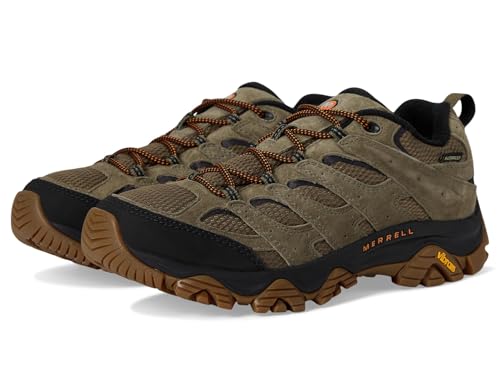
#8 Best For Big And Tall Men — Merrell Moab 3 Waterproof
The Moab has been the default hiking shoe for decades because it's comfortable straight out of the box. For big and tall men, the detail that matters is the wide width — one retailer calls it one of the widest fits out there. The upper is pig suede and mesh over a waterproof membrane, and the outsole is lugged Vibram TC5+ rubber. List runs $160–$165, and it's regularly marked down to the $100–$120 range.
There's a proportion reason too. A slim leather court sneaker can look undersized at the end of a 6'3″, 250-pound frame. The Moab has enough visual weight to balance a bigger body, the same way a chunkier watch suits a thicker wrist.
Honest drawback: It's a hiking shoe, and no one will mistake it for anything else. Choose dark brown or black, skip the two-tone grey, and wear it with jeans, flannel and a field jacket. The mesh panels also let wind through on bitter days.
Best for: Big and tall men, and anyone with wide feet who's tired of shoes that pinch.
Not every winter is wet. If you live somewhere cold and dry — Denver, Salt Lake, much of the Mountain West — warmth and comfort matter more than waterproofing. That's where the Lowmel comes in. The upper is suede and recycled ballistic canvas mesh, the insole is a 10mm UGGplush pad, and the lining is a plush blend of upcycled wool and lyocell. Expect to pay around $150.
The chunky, wide laces are designed to be worn loose. Lean into that relaxed look with straight jeans or wide-leg chinos, a heavy sweatshirt and a quilted jacket. It's also a great travel shoe for cold-weather trips: easy on and off at security, warm on the plane.
Honest drawback: It is NOT waterproof. Suede and mesh in slush is a bad combination, and the lightweight sugarcane-based EVA outsole isn't built for ice. Treat suede with a protector spray before the first wear, and leave these at home on slushy days.
Best for: The man in a dry, cold climate who wants comfort first, or a cozy shoe for winter travel.
#10 Best For Rain And Slush — Columbia Peakfreak II OutDry
Most waterproof shoes put the membrane inside, like a sock, so the outer fabric can still get soaked and heavy. Columbia's OutDry flips that. The waterproof-breathable membrane is bonded to the outer shell, so water has nowhere to soak in. Add an Adapt Trax outsole for wet and dry traction, a Techlite+ foam midsole and a Navic Fit system that locks the midfoot down, and you have a light shoe for wet commutes.
List is $130, Amazon sells it directly, and it has dipped under $90 there. For Seattle, Portland or any city where winter means rain and slush more than deep snow, this is the pick.
Honest drawback: No insulation, and it has the same technical hiker look as the Anylander. If you want one shoe that does rain AND cold, the Fairbanks is the better buy. If you only need rain and slush, this is lighter and less bulky.
Best for: The commuter who deals with rain and slush far more often than snow.
How To Wear Winter Sneakers Without Looking Like You're Headed To The Trailhead
Rule 1: Get the fit right first, because nobody can fix it later. A tailor can hem your trousers. Nobody can add room to a shoe that's too short. Shop for winter sneakers in the afternoon, when your feet are at their largest, and wear the wool socks you'll actually wear in January. You want a thumb's width at the toe and no pressure across the widest part of your foot. Then fix the trousers: winter fabrics are heavier, so take your hem to a slight break or no break at all so the cloth doesn't pool on top of a chunkier shoe.
Rule 2: Match the shoe's weight to your build and your clothes. Slim, average-height men look best in the sleeker pairs — the ECCO and the Cole Haan — because a heavy shoe makes a narrow frame look like it's wearing someone else's feet. Bigger, broader men can carry the Merrell, the Danner or the Vans, where a dainty sneaker would look undersized. Stick to dark, earthy colors: black, chocolate brown, charcoal, olive. They hide salt and slush and match the coats you already own.
Rule 3: Dress them up or down with what surrounds them. The shoe doesn't decide the formality. The outfit does. Smooth leather low-tops go with wool trousers, chinos, a knit polo or a turtleneck, and an overcoat — that's smart casual that holds up to slush. Suede and lugged soles go with denim, flannel, chore coats, waxed jackets and field jackets. Technical shoes go with technical outerwear. Mixing a trail runner with a tailored camel overcoat is where most men go wrong.
One practical rule to finish: never cotton socks in winter. Cotton holds sweat, and wet feet get cold fast even inside a waterproof shoe. Merino wool keeps you warm when damp and doesn't smell after a long day. Your sock is half of your winter footwear system.
How To Care For Winter Sneakers So They Last
Road salt is what kills winter footwear, not snow. When you get home, wipe the uppers with a damp cloth. For white salt lines on leather, use a 50/50 mix of water and white vinegar, then wipe again with plain water. Pull out the insoles, stuff the shoes with newspaper, and let them dry at room temperature. Never on a radiator or next to a heater — direct heat cracks leather and can weaken glued seams.
Rotate two pairs if you can, so each pair gets a full day to dry out. Brush suede once it's dry to lift the nap, and re-treat suede and textile uppers with a water-repellent spray a few times a season. A membrane keeps water out of your sock, but the outer fabric still needs protection to look good in March.
Winter Sneaker Questions Men Actually Ask
Are winter sneakers as warm as boots?
Most aren't, because most aren't insulated. A few are close. The Columbia Fairbanks Omni-Heat carries 200g of insulation and is rated to -25°F, which is real boot territory. For a low-top, warmth comes mostly from your sock, so pair it with heavyweight merino.
Should you size up for winter sneakers?
Usually by half a size, if you wear thick wool socks. Always try them on with the socks you'll actually wear. The exception is a shoe the brand says runs large — Cole Haan says this about its waterproof golf Topspin — where your normal size may already leave room.
Can you wear sneakers in the snow?
Yes, if they have a real waterproof membrane and a lugged rubber outsole. For anything deeper than a few inches, choose a higher, insulated shoe like the Fairbanks, which keeps snow from spilling in at the ankle. For deep snow and shoveling, wear actual boots.
What's the difference between waterproof and water-resistant sneakers?
Water-resistant means the surface was treated to shed light rain. Waterproof means there's a membrane, usually with sealed seams, that blocks water completely. Water-resistant shoes soak through in slush. Read the specs — the UGG Lowmel and the Vans Ashwood on this list are water-resistant at best, and I'd keep both out of slush.
Pick One And Wear It This Week
Most men need two winter sneakers: a sleek leather pair for town and a rugged, lugged pair for the days the weather turns ugly. You don't have to buy both today. Start with the one that fits your life.
If you dress business casual, start with the ECCO Street 720 GTX or the Cole Haan GrandPrø Topspin Waterproof. If you're on a budget, the adidas Terrex Anylander Rain.Rdy keeps your feet dry for under $90. If your winter means single digits and real snow, get the Columbia Fairbanks Omni-Heat and stop fighting cold toes.
Pick one, try it on with your winter socks, and wear it this week. Cold, wet feet are optional.
I'm Antonio Centeno, the founder of RMRS. I'm a former Marine Corps Officer with a BA in Evolutionary Biology and Philosophy (Cornell College 98') and an MBA from The University Of Texas at Austin (07'). I studied the Science of Style in London, Hong Kong, and Bangkok and have created over 5000 videos/ articles to help men dress better. Click here to discover more about me and our mission here at RMRS.
Ready to earn more money and command respect with the right clothing? Want to start dressing sharp today? Click here to discover The Style System , the BEST Professional Style Course on the planet!